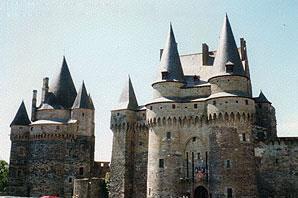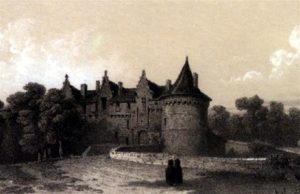
Château de La Bretesche at Missillac
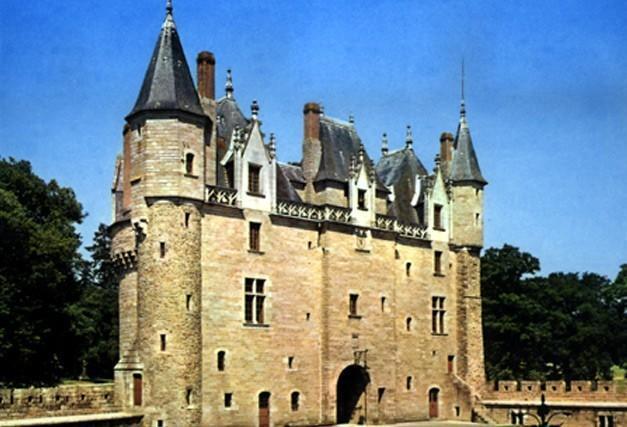
This château is regarded as the birthplace of Breton Protestantism. In 1558, François d’Andelot, brother of Admiral Coligny, invited the entire Breton high nobility—the Rohans, the Lavals, the Rieux, the Parthenays—to hear a Protestant sermon. He succeeded in engaging more than a hundred families of ancient nobility, who embraced Calvinism.
Among those present at this historic preaching was François de La Noue, known as “Iron Arm”, who fought for the Reformed cause until his death.
Subsequently denounced by the Catholic Church, François d’Andelot was imprisoned at Melun. He is said to have replied to King Henry II, who had him brought before him for judgement: “Sire, my life and my goods are all yours, save my conscience.”
The fortified château of La Bretesche, residence of the Barons of La Roche-Bernard in the Middle Ages, was built in the fourteenth and fifteenth centuries. Destroyed during the Revolution, it was rebuilt in the nineteenth century.
La Roche-Bernard
François d’Andelot-Coligny became Baron of La Roche-Bernard through his marriage to Claude de Rieux (1547). He transformed the chapel of Notre-Dame into a temple, where Protestant services were held from 1561 onwards. The pastor Louveau preached there for forty years, followed by the pastors André Le Noir and then Guy Le Noir.
La Roche-Bernard was one of the three Protestant strongholds of Brittany, together with Blain and Vitré. The town, which overlooks the Vilaine and its port, was taken by the Duke of Mercœur in 1589. He had a fort built there in order to control the estuary of the Vilaine.
In the Rue de la Tour de l’Isle lies the former Protestant quarter, whose cellars and attics of the houses were interconnecting so facilitating the discretion of meetings.
Blain

This medieval fortress, built by Olivier de Clisson in the twelfth century and enlarged in the thirteenth and fourteenth centuries, became, through the marriage of Beatrix de Clisson to Alain VIII de Rohan, the stronghold of the Rohan family. From the time of the Rohans’ conversion to Protestantism, Blain housed an important Protestant church.
Catherine de Parthenay, wife of René de Rohan and a leading Huguenot figure, resided there and carried out certain alterations. Her son, Henri de Rohan, was the last leader of the Huguenot party.
The château became the seat of a literary circle around Catherine de Parthenay and later her daughter-in-law, Marguerite de Béthune, daughter of Sully.
The château was demolished on the orders of Richelieu in 1628 after the siege of La Rochelle, and subsequently rebuilt.
Le Croisic
At Le Croisic, François d’Andelot-Coligny established the Reformation. During a demonstration on 17 June 1558, the Huguenots provoked the Catholics, and for this reason François d’Andelot was imprisoned by Henry II.
The Château of Careil
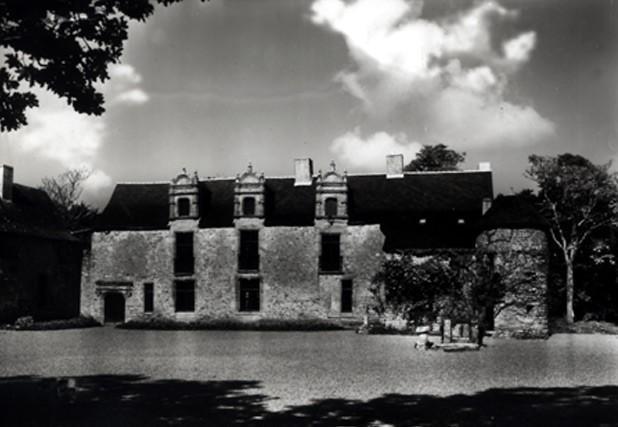
Near Le Croisic, this thirteenth-century château belonged to the du Bois, known as du Boulac family, one of the first to convert to Protestantism in 1558, following the sermon at the Château de La Bretesche. At the time of the Revocation, the family remained faithful to Protestantism and went into exile in Holland.
The château hosted numerous services. Visitors may see the “pastor’s chamber”, where Pastor Claude Loiseleur stayed from 1558 onwards.
Nantes


The city of Nantes became, in the fifteenth century, the residence of the Dukes of Brittany and the capital of Brittany. It owed its economic growth to its port.
In Protestant memory, Nantes is associated with the Edict of Nantes, signed by Henry IV at the end of April 1598 in the Château of the Dukes of Brittany. This edict permitted, for nearly a century, the coexistence of Protestants and Catholics in France.
From that time onwards, worship was held at Sucé, on the banks of the Erdre, which the Huguenots would ascend by boat to reach the temple, singing psalms. Today, a cruise on the Erdre recalls this period and offers a view of the Renaissance château of La Gascherie, once owned by François de la Noue, nicknamed the “Huguenot Bayard”.
In the seventeenth century, the Huguenot quarter lay beyond the confluence of the Erdre, near the Quai de la Fosse. It was known as “Little Holland” on account of the large number of Dutch nationals who had settled in what was then the largest port in France.
At the time of the Revocation, the port of Nantes served as a point of departure for many Protestants fleeing to the countries of the Refuge, sometimes concealed in barrels.
During the eighteenth century, however, businessmen continued to arrive from Holland and Germany to engage in trade and in the manufacture of the highly prized printed fabrics of the time, known as “indiennes”. Services were held among these foreign nationals, either in their homes or in their “indiennes” manufactories. Wealthy merchants settled on the islands of the Loire, particularly on the Île Feydeau, where one may admire fine eighteenth-century townhouses.
The Dobrée Museum recalls the history of the Dobrée family, a Protestant Norman family exiled to Guernsey, one of whose descendants returned to France and settled in Nantes in 1775. This family, connected with maritime trade and the development of shipyards, acquired considerable wealth. Thomas Dobrée (1810–1894) became a discerning collector and, upon his death, bequeathed his extensive collection of works of art and his palace to the city of Nantes.
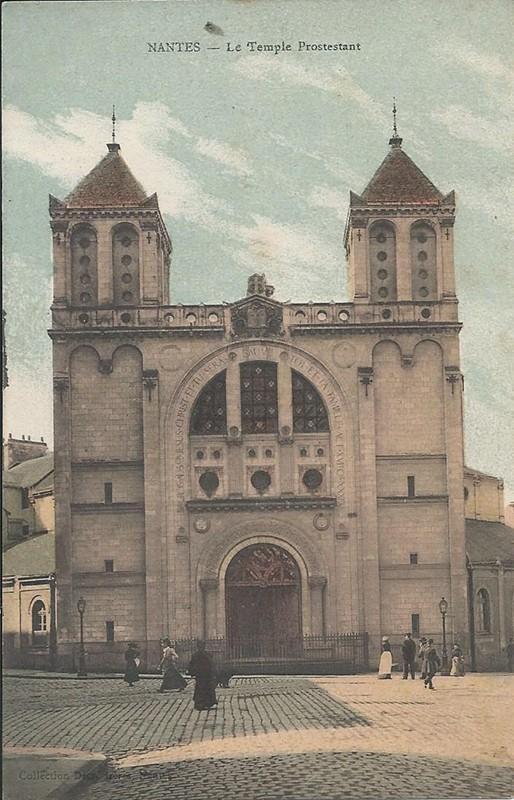
The Protestant church of Nantes, on the Place Édouard Normand, rebuilt after the Second World War, now houses a living community.