The first Protestant church in the Orléans region, inaugurated in 1599 and known as the Temple of Bionne, was built at Chécy, eight kilometres from Orléans, in accordance with the Edict of Nantes. It was demolished following the Revocation of the Edict in 1685.
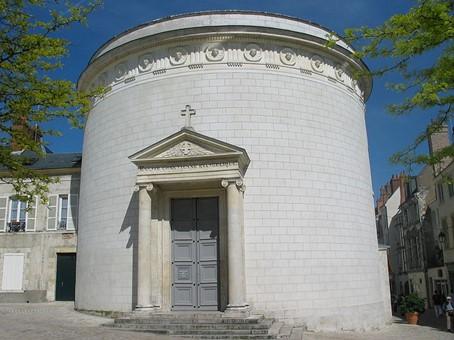
It was not until 1835 that a new Protestant church, circular in form, was constructed in Orléans. Designed by François-Narcisse Pagot, an Orléans architect deeply influenced by classical culture, it was built on the site of the former Church of Saint-Pierre-Empont. Inaugurated in 1839, it was conceived according to the principle of gathering the community around the Bible, read and interpreted within a functional circular space that unites the congregation in a spirit of communion.
The entrance portal features an Ionic pediment surrounded by four columns; the rotunda is crowned by a frieze decorated with radiant medallions and angelic masks. It is one of the few circular Protestant churches in France. Included in the supplementary inventory of historic monuments in 1969, it has enjoyed official protection since 1975.
The circular model is also found in other Protestant churches, such as those of Lasalle in the Gard, Les Vans in the Ardèche, and Saint-Gelais in Deux-Sèvres.