The Success of an Industrial Entrepreneur
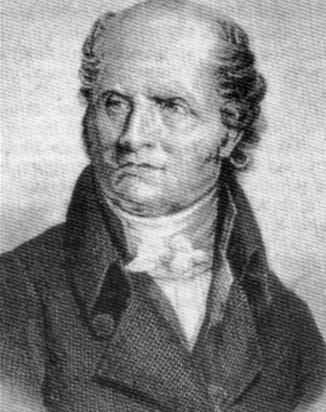


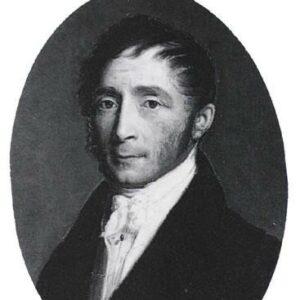
Christophe-Philippe Oberkampf, born in Wiesenbach (Brandenburg-Ansbach), descended from a line of Lutheran dyers from Württemberg. He learned the trade from his father, who had settled in Aarau, Switzerland, as a manufacturer of printed cottons (indiennes).
In 1756, at the age of eighteen, the young Oberkampf gained his independence and joined the printing works of Samuel Koechlin and Henry Dollfus in Mulhouse as an engraver. In 1758, he entered the employment of Monsieur Cottin, in the Arsenal district of Paris, first as an engraver and later as a colourist.
In 1760, in partnership with Antoine de Tavannes, he printed his first textiles at Jouy-en-Josas. The site offered several advantages: it lay beside the River Bièvre, in a rural valley where land was available, and it was situated near Versailles.
In the early years, Oberkampf benefited from his father’s assistance: the blue-printing process invented by his father, the dispatch of skilled workers, and the purchase of wide-width fabrics and dyeing materials that were difficult to obtain in France.
Oberkampf acquired land and erected new buildings in 1764, 1765, 1791, and 1805 in order to keep pace with growing demand for printed textiles.
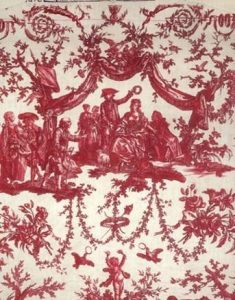
The manufactory’s production enjoyed immense success both in France and abroad. The royal court admired the quality of the indiennes of Jouy and the beauty of their designs.
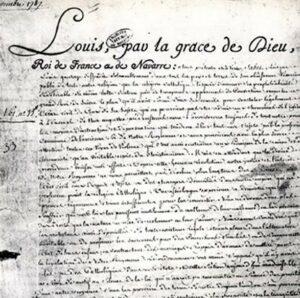
In 1770, Oberkampf obtained French naturalisation. In 1783, King Louis XVI granted the establishment at Jouy the privileges of a Royal Manufactory and, in 1787, conferred letters patent of nobility upon Oberkampf.
The Revolution, the Consulate and the Empire
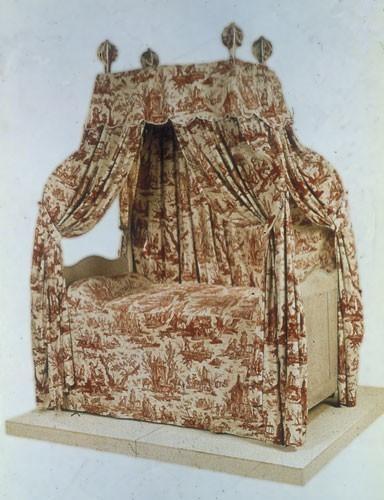
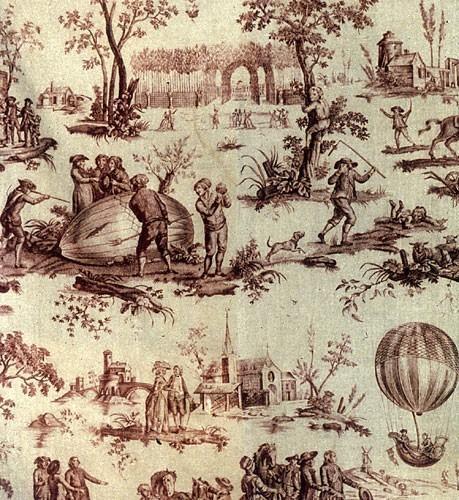
During the Revolution, Oberkampf succeeded in keeping his manufactory operational through considerable skill and the cohesion of his entire family, albeit at the cost of a certain political opportunism. He subscribed to state loans, had himself elected mayor of Jouy in 1790, and was re-elected in 1791. The National Guard of Jouy, formed in 1791, was commanded by his nephew Samuel Widmer, while the Popular Society of Jouy, created at the end of 1793, counted Samuel Widmer and James Petineau, respectively Oberkampf’s nephew and brother-in-law, as its president and secretary. In 1794, the manufactory was declared useful to the Republic by the Committee of Public Safety and received a visit from Georges Couthon, one of its members.
Nevertheless, in 1794, an engraver at the manufactory named Voët accused Oberkampf of “moderation” and royalist sympathies and denounced him to the Committee of General Security. Fortunately, the complaint came to nothing. Oberkampf would later agree to re-employ Voët at the manufactory.
Under the Consulate, business revived: by 1803, the workforce had risen to more than 1,300 employees. The Jouy manufactory had become the third-largest industrial enterprise in France, after the Anzin Mines and the Saint-Gobain glassworks.
In 1806, Napoleon himself visited Jouy, accompanied by Empress Joséphine, and awarded Oberkampf the Légion d’honneur. Napoleon returned again in 1810 with Empress Marie-Louise.
To overcome difficulties in obtaining cloth supplies, Oberkampf purchased the Chantemerle estate at Essonnes, where he established a spinning mill and weaving works that commenced operation in 1810.
The region around Jouy was occupied by Cossacks in 1814 and by Prussians in 1815. The manufactories were forced to cease production.
It was then, in October 1815, that Oberkampf died after fifty-five years of industrial activity. He had succeeded despite being a foreigner, unable initially to speak French, a Protestant who had arrived in France before the Edict of Toleration of 1787, and without financial resources.
He founded an industry that endured for 134 years.
Continuation of Industrial Activity after Oberkampf’s Death
The division of Oberkampf’s estate was not completed until the end of 1820. The Jouy manufactory was taken over by Émile, Oberkampf’s son. In 1821, Émile entered into partnership with Samuel Widmer, but Samuel died that same year. Émile then partnered with Jacques Juste Barbet, known as “de Jouy”.
In June 1822, Barbet became sole proprietor, as Émile Oberkampf was compelled to retire on grounds of ill health. Decline soon followed. Industry gradually supplanted craftsmanship, printed textiles were produced ever more cheaply, and tastes and fashions changed.
The closure of the manufactory became final in 1843. The industrial heritage was dispersed and most of the buildings demolished.
Today, only part of Oberkampf’s house remains, now serving as the town hall of Jouy-en-Josas, along with the former calendar mill, heightened at the beginning of the twentieth century.
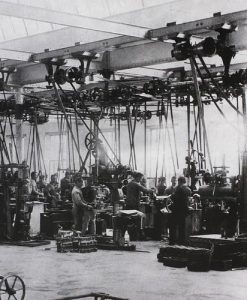
The Essonnes spinning mill proved more enduring. It was taken over by Louis Feray, Oberkampf’s son-in-law, and later directed for fifty years by Ernest Feray, Louis’s son and Oberkampf’s grandson, who developed a mechanical engineering workshop producing turbines, hydraulic pumps, and equipment for milling and paper-making. The establishment remained within the family until its closure in 1894, three years after Ernest Feray’s death.
A Protestant Family
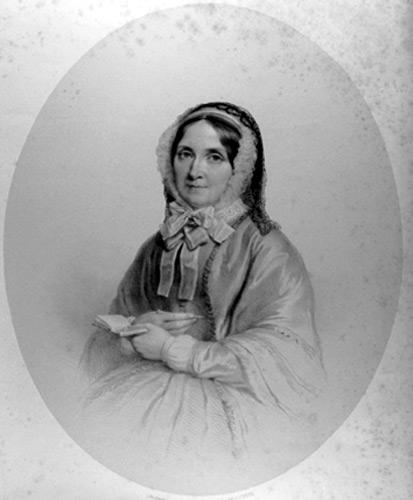
The year-by-year history of Oberkampf’s life, family, and the Jouy manufactory was recorded by one of his nephews, Gottlieb Widmer, in the Mémorial de la manufacture de Jouy, a copy of which is preserved at the Musée de la Toile de Jouy.
Oberkampf’s first marriage, to Marie-Louise Petineau, was celebrated in 1774 by a Lutheran pastor at the Swedish embassy in Paris, without waiting for the requested royal authorisation. When this authorisation finally arrived seven years later, the couple had their union blessed once more, this time at the Dutch embassy in Paris by the Calvinist chaplain. The record notes that their children had been recognised as legitimate and baptised in the Catholic parish of Jouy, thereby granting them official civil status.
When Madame Oberkampf died in 1782, her ashes were buried in the manufactory garden, since burial in the Catholic cemetery was impossible. No formal entry appears in the parish register: only an unsigned abbreviated note survives on the final page.
Oberkampf remarried Élisabeth Massieu de Clerval in 1785. The marriage was celebrated in the chapel of the Dutch embassy, this time with royal permission obtained in due course.
Only four of Oberkampf’s children survived into adulthood: Julie from his first marriage, and Émile, Émilie, and Laure from his second marriage.
Oberkampf took great care to establish both his children and his six nephews within French Protestant society. Numerous marriages linked the Oberkampf family with several Protestant families, including the Petineau, Massieu, Feray, and Mallet families. Thus Émilie and Laure Oberkampf married the brothers Jules and James Mallet.
To assist him in business, Oberkampf first brought in his brother Frédéric, for whom he later purchased a small textile-printing manufactory at Corbeil known as l’Indienne. He surrounded himself with his six Widmer nephews, whom he brought from Switzerland, his two Petineau brothers-in-law, and later his sons-in-law Louis Feray and Jules Mallet, as well as his son Émile Oberkampf.
Samuel Widmer was responsible for several inventions that contributed significantly to the technical superiority of Oberkampf’s manufactories.
The importance and renown of Oberkampf’s industry have been such that his name was given to a street and a Paris Métro station, and the bicentenary of his death was included among the official national commemorations of 2015.