History of Printed Fabrics
The printing of floral motifs on fabric is of great antiquity. It was in India, a major producer of cotton textiles, that wash-resistant dyes were developed from the earliest centuries, together with methods of engraving in intaglio or relief for the printing of inexpensive fabrics.
From the Middle Ages onwards, these cotton textiles were exported throughout the East and the Middle East, eventually reaching European markets in the seventeenth century. They were used both for clothing and furnishings. Around 1660 they began to appear at the fairs held in the vicinity of Paris, renowned for their commercial importance. They were appreciated for their lightness, the cheerfulness of their colours and patterns, and for satisfying the taste for exoticism that became fashionable among women following the embassy of the King of Persia to France in 1686.
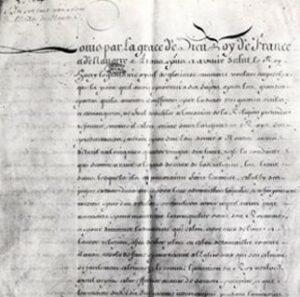
However, in 1686, a decree of the Conseil d’État prohibited both the importation and manufacture of painted cotton fabrics in order to protect the silk, wool, linen and hemp industries. Subsequent ordinances ordered the destruction of the engraved wooden blocks required for textile printing. Coming shortly after the Revocation of the Edict of Nantes, this prohibition forced many craftsmen into exile or clandestine activity, particularly Protestant artisans from the Gard region. It encouraged the establishment of cotton-printing manufactories in Switzerland, especially in the Canton of Neuchâtel, of which the most renowned was that of Le Bied. Smuggling flourished and, despite the ban, clandestine production became organised.
Gradually, the repression lessened. Madame de Pompadour wore printed cottons and used them to upholster the furnishings of her Château de Bellevue; she contributed to the general authorisation for textile printing granted in 1759.
Many manufactories that had opened in haste subsequently failed through lack of skilled workers, with the notable exception of Alsace, where cotton printing rapidly developed into a highly dynamic industry.
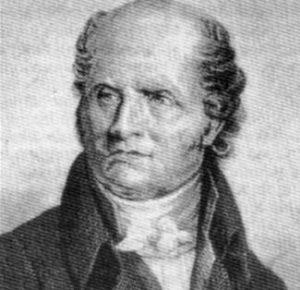
Christophe-Philippe Oberkampf (1738–1815), first trained by his father in Aarau, Switzerland, and later at Koechlin-Dollfus in Mulhouse, then not yet part of France, subsequently joined the Parisian engraver M. Cottin. In 1760, having mastered all the techniques of textile printing, he chose to establish himself outside Paris at Jouy-en-Josas, near Versailles, on the banks of the Bièvre. There he founded a textile-printing manufactory that became both important and widely celebrated.
Following Oberkampf’s death, production continued under his son Émile, who sold the business in 1822 to Jacques Juste Barbet, known as “de Jouy”. Barbet closed the manufactory in 1843, bringing to an end eighty-three years of textile printing.
The Beauty of Toile de Jouy Designs
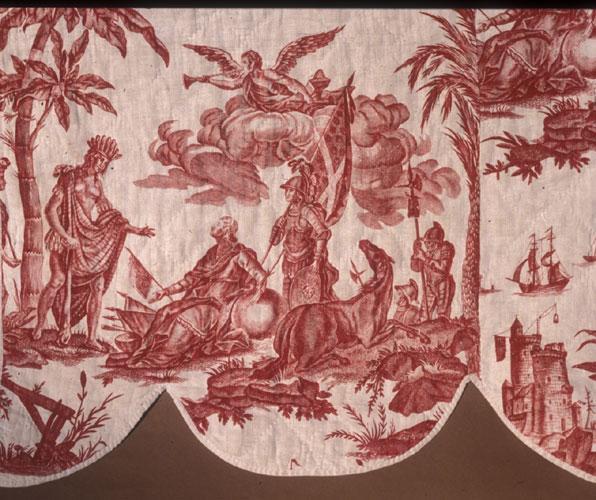
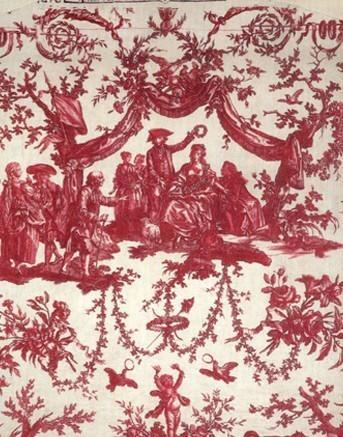
It is above all the beauty and variety of the printed designs, executed in one or several colours, that established the reputation of Jouy. These included scattered floral motifs and garlands designed either by artists attached to the manufactory or by independent designers; figurative scenes, romantic episodes inspired by popular novels, children’s games, and animals drawn from La Fontaine’s fables. This decorative repertoire evolved continuously thanks to the contribution of accomplished artists, some of whom were well-known painters: Chardin, later Heim and Demarne, and above all Jean-Baptiste Huet (1745–1811).
At the height of the cashmere fashion, printed fabrics incorporating these Oriental-inspired motifs rivalled silks that remained prohibitively expensive for most women.
Towards the end of the eighteenth century, contemporary events began to appear on the fabrics: the American War of Independence, the Festival of the Federation, and the first balloon flights. From 1797 onwards, mythological and classical subjects became increasingly prevalent. From 1807, the manufactory also produced fabrics decorated with architectural motifs, particularly Egyptian-inspired designs based on drawings by J.-B. Huet.
Today, the term Toile de Jouy remains widely recognised, and Jouy designs continue to occupy an important place within the decorative arts, where they are still reproduced.
Improvements in Printing Techniques
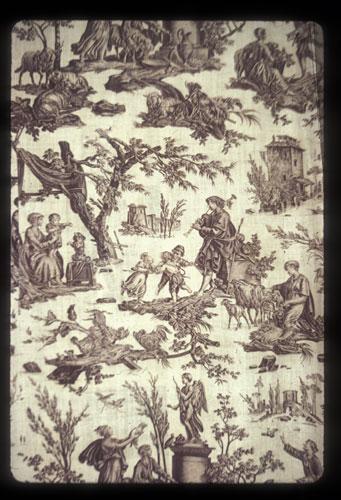
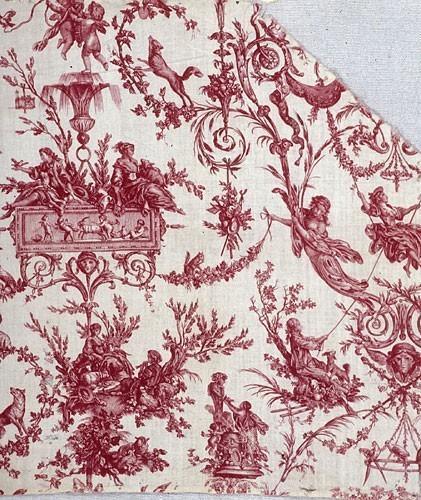
Oberkampf remained steadfastly committed to the quality of the fabrics he printed and never departed from the principle of bon teint (“fast colours”), which characterised prints capable of withstanding repeated washing.
Textile printing required numerous operations, and it was the meticulous execution and careful sequencing of these processes that ensured the durability of the colours on Jouy fabrics, thereby contributing significantly to their reputation.
Lengths of cloth were first beaten, washed and bleached to remove their dressing, then dried in a heated chamber. Spread out on a table, the fabric received impressions from engraved wooden blocks coated with dye: each colour required a separate block, which was repeatedly repositioned to reproduce the design. Inexpensive wooden blocks made it possible to produce a wide variety of patterns in relatively small runs.
Once the colours had been printed, the fabric was thoroughly rinsed to prevent the dyes from damaging the cloth. It was then dried in the open air on the meadows.
Having been informed by his brother of a Swiss competitor’s use of copper plates for printing, Oberkampf began, from 1770 onwards, to adopt this technique, which produced designs of considerably greater refinement than those obtainable with wood.
Oberkampf sent his nephew, Samuel Widmer, to train under the chemist Claude Louis Berthollet (1748–1822), who discovered the bleaching properties of chlorine. This innovation was introduced at Jouy in 1793 for bleaching fabrics prior to printing.
From 1797, the use of intaglio-engraved copper rollers enabled printing to be carried out far more rapidly. A further improvement followed from 1800 onwards with the introduction of machinery capable of automatically engraving copper cylinders and plates.
Oberkampf continually expanded the production capacity of the Jouy manufactory. In 1805, he printed white designs onto pre-dyed fabrics by means of a mordant that removed the colour. This process proved particularly well suited to roller printing.
In 1810, Samuel Widmer discovered a fast green dye that could be applied in a single operation, replacing the previous process of successive blue and yellow printing. He also introduced steam to heat the dyeing vats.