An Early Calling
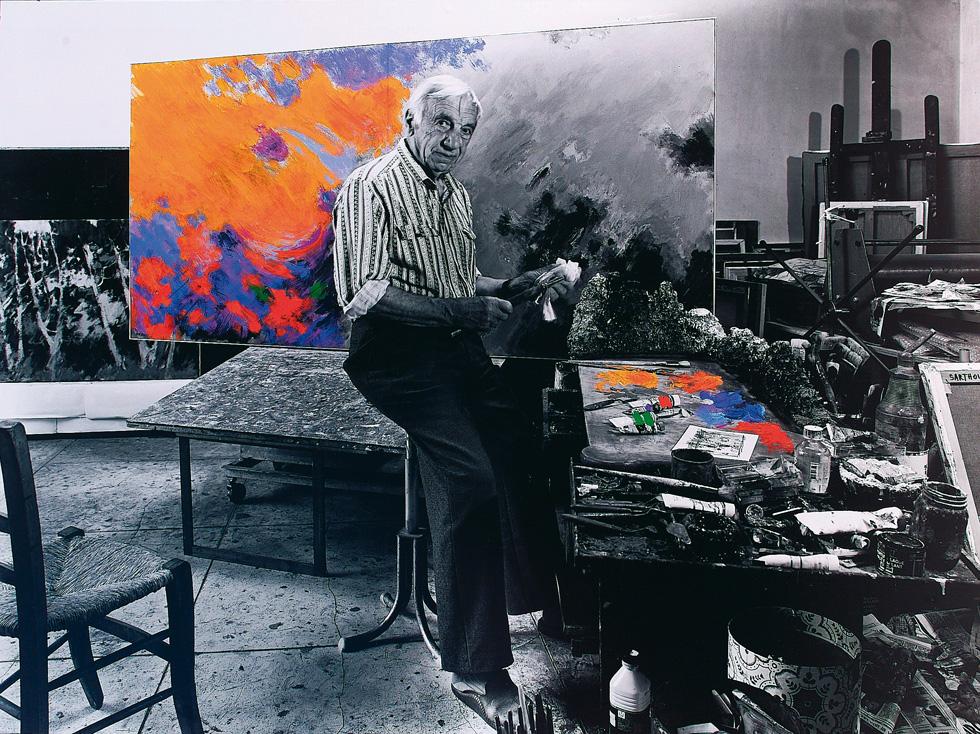
Sarthou was born in Bayonne on 15 January 1911. A war orphan, he was raised in Montpellier by his mother and grandfather, Alfred Fontaine, a railway engineer.
In 1927, he entered the École des Beaux-Arts in Montpellier on the condition that he study architecture. After one year, he persuaded his family to allow him to join the painting studio instead. Awarded a scholarship by the city of Montpellier as a ward of the nation, he entered the École des Beaux-Arts in Paris in 1930.
He met his future wife, Yvonne Dora Seo, in Lasalle (Gard); their daughter Francine was born in 1934.
Having qualified as a drawing teacher, he taught in order to earn his living. He was first appointed to Bastia in Corsica, and then, in 1937, to Bordeaux. From 1939 to 1941, he served in the war with the signals corps.
In 1943, he became a member of the Société des Indépendants Bordelais, which regularly organised exhibitions of Parisian artists (Bissière, Lhote, etc.). This artistic stimulation enabled him to affirm his own style, which was relatively realistic at the beginning of his career.
In 1949, the art critic Jacques Lassaigne, who had come to Bordeaux to preside over the regional selection for the Prix de la Jeune Peinture, noticed and selected him. At the Salon des Indépendants Bordelais, Sarthou received the Drouant-David Prize. One of the members of the jury, the art critic Gaston Diehl, invited him to Paris to exhibit at the Salon de Mai, of which he was the founder. It was the first time that Sarthou exhibited in the capital, presenting two canvases: Still Life and Open Window.
Journeys and Wanderings
Sarthou settled in Paris in 1950, where he was appointed drawing master at the Lycée Henri IV. He continued to exhibit and steadily gained renown. On Sunday mornings, he would join gatherings at the Arènes de Lutèce, where Jean Paulhan, who lived opposite, invited his friends from the Nouvelle Revue Française to play pétanque: Maurice Toesca, Jérôme Lindon, Yves Berger, Claude Simon, André Bay, Marcel Jouhandeau, and others. These were stimulating moments for the painter immersed in the Parisian literary milieu.
The painter François Desnoyer, whom he had met at the Salon de Mai, introduced him to the Parisian art dealer Marcel Guiot. A long friendship developed between the dealer and the artist; from 1955 onwards, Sarthou exhibited regularly at the Galerie Guiot, to which he remained loyal.
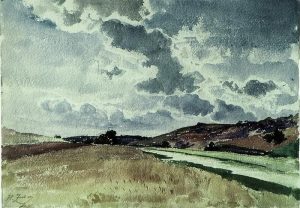
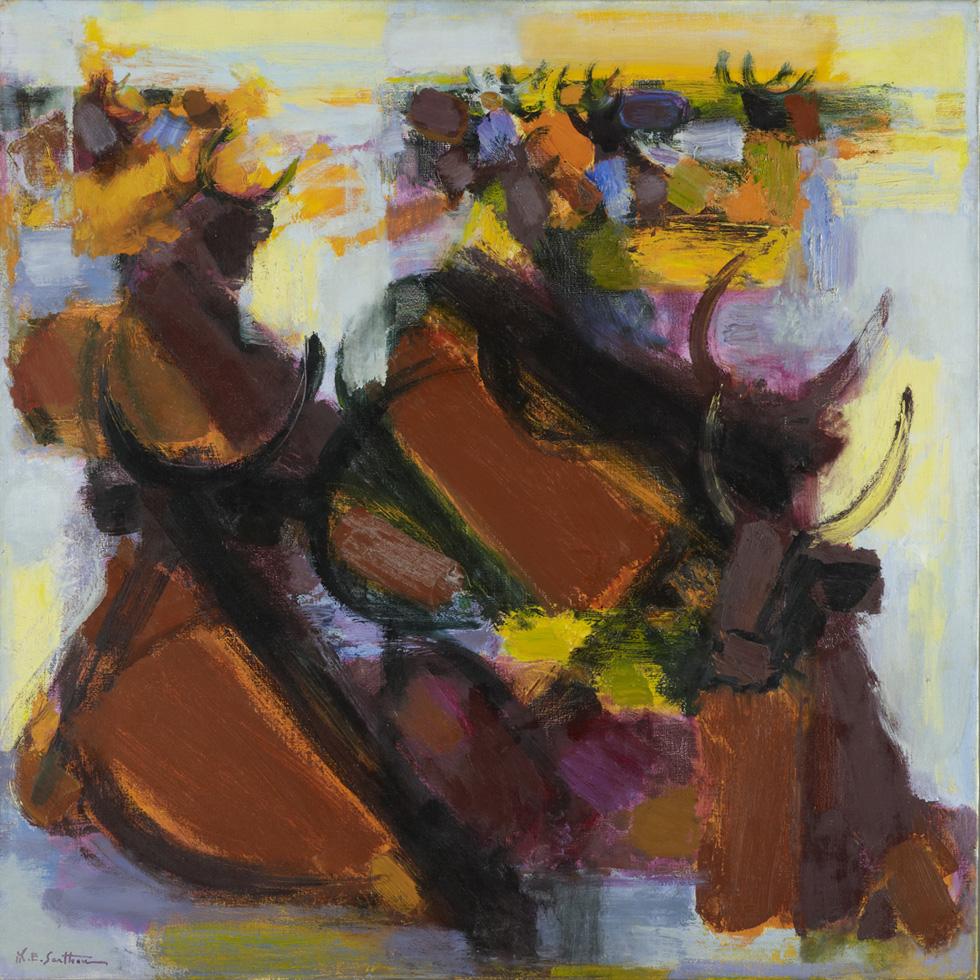
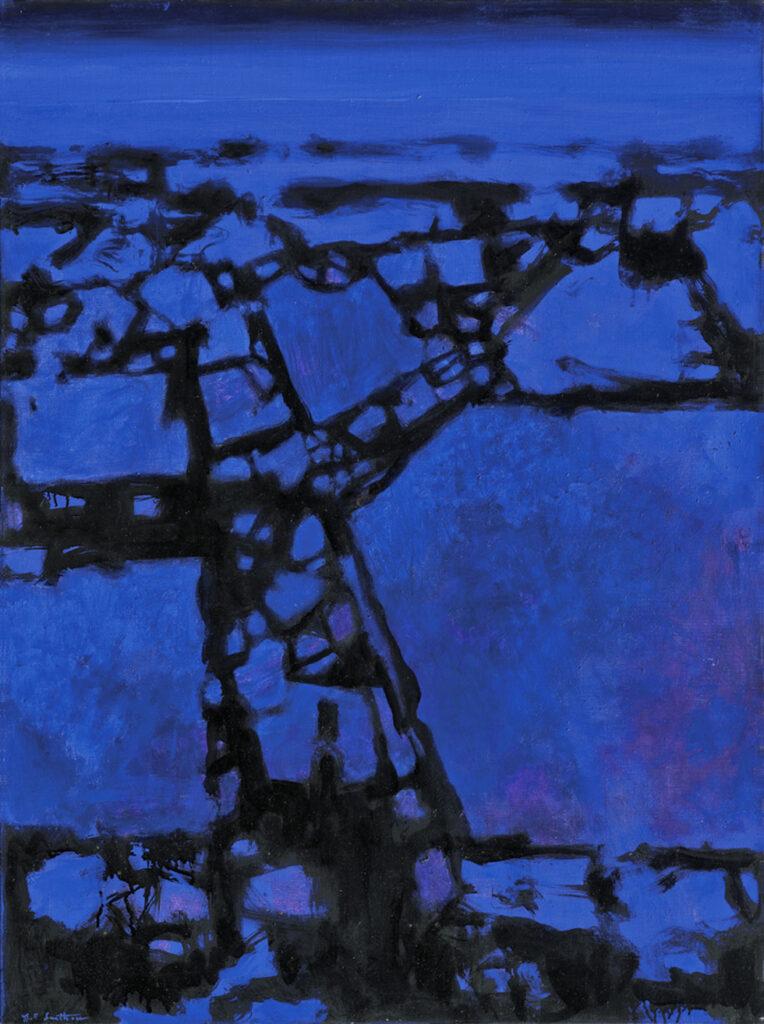
In 1952, he left the Basque coast and the Arcachon basin in favour of Languedoc and Provence. He settled in Sète, dividing his time between there and Paris. There he rediscovered the light of the Midi and explored themes such as pine trees bent by the mistral, Camargue bulls, the rocks of Les Baux, fishing villages upon the lagoon, and later, forest fire.
In 1958, he was finally able to abandon teaching in order to devote himself entirely to painting. He presented his works in group exhibitions and took part in numerous salons, notably the Salon de Mai (from 1949 to 1963) and the Salon d’Automne (from 1951 to 1987).
A Sensory Painting
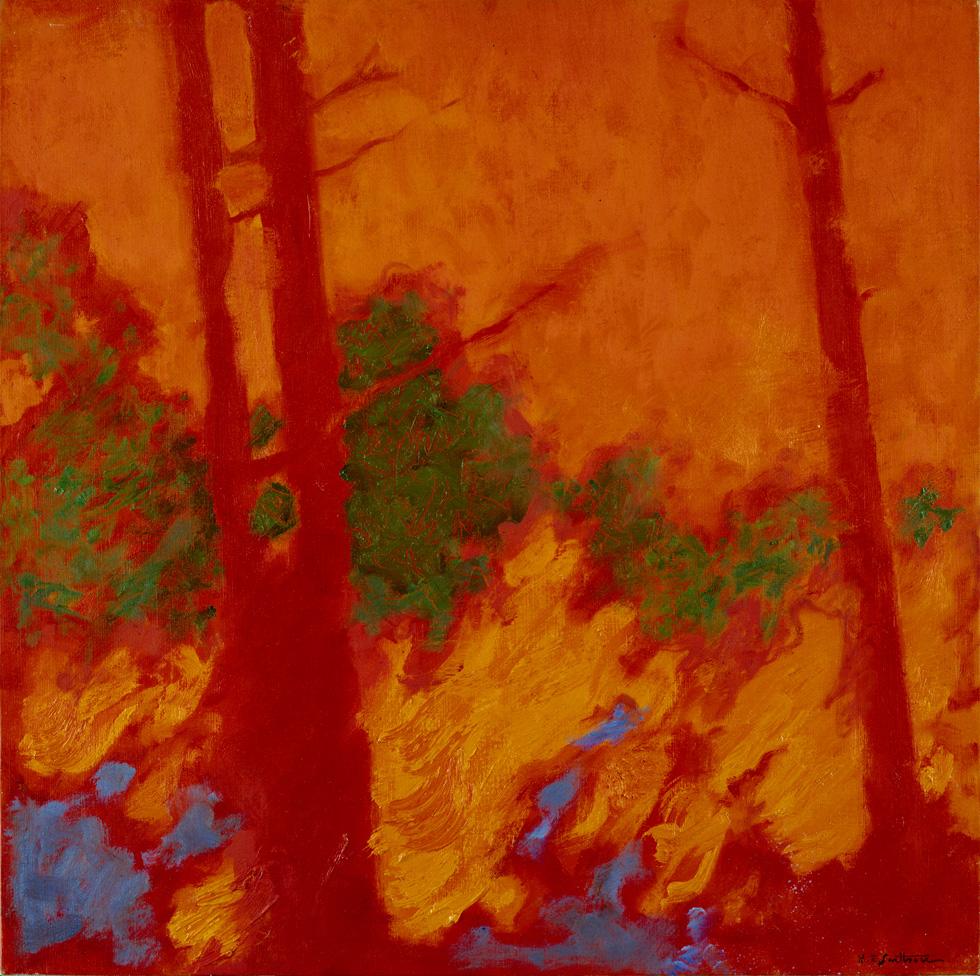
Sarthou disliked conformism, academic doctrines, and systematic non-figuration. He created what may be termed a “sensory painting”: he stood at the crossroads between figuration and abstraction. As Pierre Georgel wrote in the preface to the exhibition Sarthou at the Musée Paul Valéry in Sète in 1973:
“From the work of [Jacques] Villon, he retained the essential: the lyrical vision of nature, expressed through a colourful geometry derived from Orphism and the Section d’Or… Picasso once said: ‘It takes a long time to become young.’ Sarthou had the good fortune to rediscover the fire of adolescence at the age when others become ossified. He possesses its spontaneity and ardour, without its awkwardness. Instinct, no doubt, gives rise to the bursts, splashes, streaks, and smears of paint that sometimes make his canvases resemble the finest achievements of gestural tachisme, yet instinct alone would not suffice. This is where the reference, distant, intuitive, yet constant, to nature comes into play.”
In 1956, he painted a portrait of André Chamson, then curator of the Petit Palais in Paris, on the occasion of the exhibition Painters as Witnesses of Their Time, which Chamson co-organised.
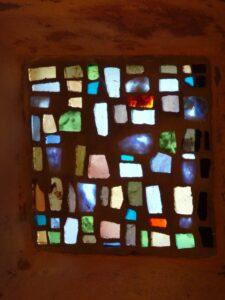
In 1962, Sarthou participated, in Reims at the workshop of the master glassmaker Jacques Simon, in the execution of two stained-glass windows for the church at Bouchevilliers, one of which, in the apse, stands beside a stained-glass window by Jacques Villon.
At the request of the publisher Jacques Vialetay, he illustrated Lou Biòu by the writer and cattle-breeder Folco de Baroncelli-Javon, selected among the fifty finest books of the year 1963 by a jury of writers and publishers from the “Permanent Committee for Exhibitions of French Books and Graphic Arts”.
In 1966, he illustrated Regards sur la mer by Paul Valéry (Éditions Vialetay), with a preface by Valéry’s daughter Agathe Rouart-Valéry, the work being selected among the finest books of 1966. At the request of the Société Normande des Amis du Livre, he illustrated Arthur Rimbaud’s Le Bateau ivre in 1967.
In 1981, he illustrated L’Épervier de Maheux by Jean Carrière (Éditions contemporaines).
Varied Friendships
Sarthou counted many Protestants among his friends: André Chamson, Jean Paulhan, Albert Finet, Pastor Gérard Delteil, Gilbert Fourcaud (deeply involved with the Lazaret of Sète), and Andrée Schlegel (wife of Jean Vilar), among others.
Several celebrated writers, museum directors, and art critics wrote prefaces for the catalogues of his exhibitions or published articles on his painting, notably Lydia Harambourg, Raymond Nacenta, Pierre Cabanne, Jean Cassou, Raymond Cogniat, Georges Desmouliez, Frank Elgar, Pierre Georgel, André Parinaud, Waldemar George, Alexander Watt, and Jean Devoisins.
In 1964, he became friends with the photographer Lucien Clergue, whom he met in Arles. United by a common ideal regarding the Camargue, the two couples remained close friends until their deaths. In Arles, he also became acquainted with Michel Tournier, who wrote several texts about him, including a preface for the exhibition at the Findlay Gallery in New York in 1974.
Official Recognition
In 1953, he received the second Bührle Prix; a year later, the second Dôme Prize, awarded by a jury composed exclusively of painters including Jacques Villon, Desnoyer, André Lhote, Pignon, and Singier. In 1955, he received the Prix de la Critics’and, in 1957, the first City of Menton Prize at the Biennale. In 1980, he was awarded the Grand Prix of the 7th International Biennale of Mérignac. In 1985, he received the Grand Prix de l’Orangerie at the Château de Versailles.
In 1961, the art critic Jean-Albert Cartier invited Sarthou to participate in the exhibition Ten French Painters around Jacques Villon at the Palais de la Méditerranée in Nice; on this occasion Jean Paulhan wrote a laudatory text about Sarthou. The exhibition subsequently toured, notably to the Musée des Beaux-Arts in Nancy, to Tours, and to Luxembourg.
In 1972, Josée Dayan produced a documentary for FR3 Toulouse entitled Sarthou or the Painter of the Elements, based on an idea by Marc Alyn and Madeleine Attal.
In 1976, Sarthou formed part of the French delegation for the travelling exhibition in Japan Selection from the Salon d’Automne of Paris: “Contemporary Masters” – Nika-Kai Exhibition. His flight over the Pole inspired a new theme in his work: the polar ice pack.
In 1977, during the inauguration of the Centre Pompidou, one of the preparatory washes for his canvas The Dunes, acquired by the French State, was exhibited in the Cabinet des dessins.
His works are present in numerous institutions in France and abroad: the Toulouse-Lautrec Museum in Albi, the Fabre Museum in Montpellier, the Paul Valéry Museum in Sète, the Réattu Museum in Arles, the National Contemporary Art Collection at Paris-La Défense, the National Museum of Modern Art, the Museum of Modern Art of the City of Paris, the National Library of France, and foreign museums (the National Museum of History and Art in Luxembourg, the Sofia Museum, the Museum of Art and History in Geneva, the museums of Stanford and Princeton Universities, the Cincinnati Art Museum, etc.).
Sarthou died in Paris on 11 June 1999; he was buried in the Marine Cemetery at Sète, as was his wife in 2002.
Since his death, several retrospective exhibitions have been devoted to him, both in France and abroad.
Conclusion
Throughout his career, Sarthou produced more than 1,700 oil paintings, nearly 900 watercolours, gouaches, washes, drawings, and pastels, more than 100 lithographs, illustrated books, tapestry and stained-glass cartoons, as well as mural decorations.
Jean Paulhan said of Sarthou:
“A man of the South, he must constantly narrow his eyes in order to preserve some semblance of form which the sun was on the verge of consuming. […] He has to ruin his canvas, then begin again. And fail again […] Sarthou works with rigour. He brings to mind a moralist. It so happens that this moralist is, fortunately, joyful; and such invigorating rigour is not so common. For at no moment does the painter wholly believe in his visions. He leaves room for the obscure.”