The formative years
He trained himself by reading numerous classical art publications. Of fragile health in his youth, he spent many stays in Abbévillers in the Doubs region with farming families, where he met Élisabeth Vergon, an early portrait painter and former student of the École des Beaux-Arts. She offered him extensive guidance and, above all, introduced him to the circle of Montbéliard painters, among whom he encountered Paul-Élie Dubois (1886–1949) and, most notably, Jules-Émile Zingg (1882–1942), whose advice shaped his earliest works. In 1937, having received the prize of the Doubs General Council, he left the Peugeot-Frères factory in Hérimoncourt, where he had worked as an industrial draughtsman in the methods department since 1926, in order to pursue a career as a painter. Until the 1950s, his work remained largely under the influence of Jules-Émile Zingg. Figurative in style, it includes numerous landscapes of the countryside, rendered in muted tones with soft and at times sombre lighting.
The discipline of drawing
Stung by a critic’s remark about his work, “You paint as if Picasso had never existed”, he turned during the war to drawing. The intensity of this practice enabled him to free himself from the influence of Zingg’s art. He then developed his own style, which resonated with the explorations of more contemporary artists. In certain drawings, for example, the linear arrangement of bodies within space evokes the schematic forms of the Stations of the Cross in the Chapel of the Rosary (1948–1951) by Matisse in Vence. The anonymity of faces, stripped of detail, leaves full scope for the viewer’s imagination. At the same time, his interest in Cézanne brought him close to the Cubism of Jacques Villon (1875–1963), a resemblance visible in the geometrisation of compositional structures, the fragmentation of planes, and the schematic treatment of figures, which nevertheless retain formal coherence.
Mural work
In 1951, he settled in Paris as a professional artist. He exhibited at the Salon des Indépendants, the Salon d’Automne, and in several galleries in Paris, Basel, Casablanca and Barcelona.
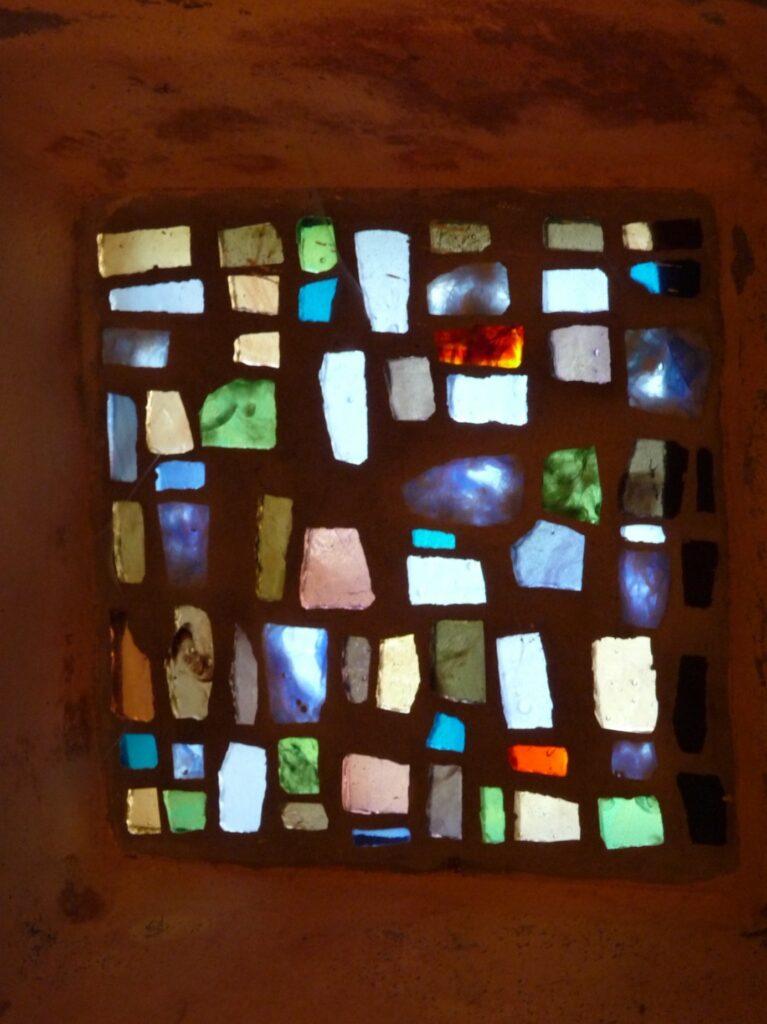
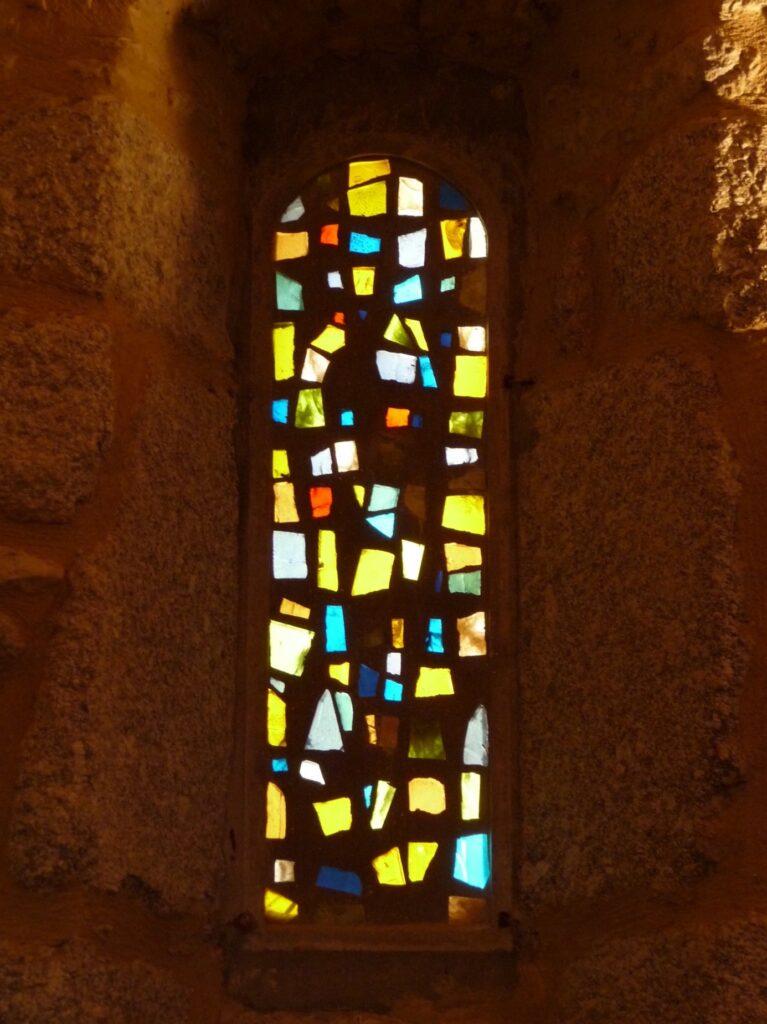
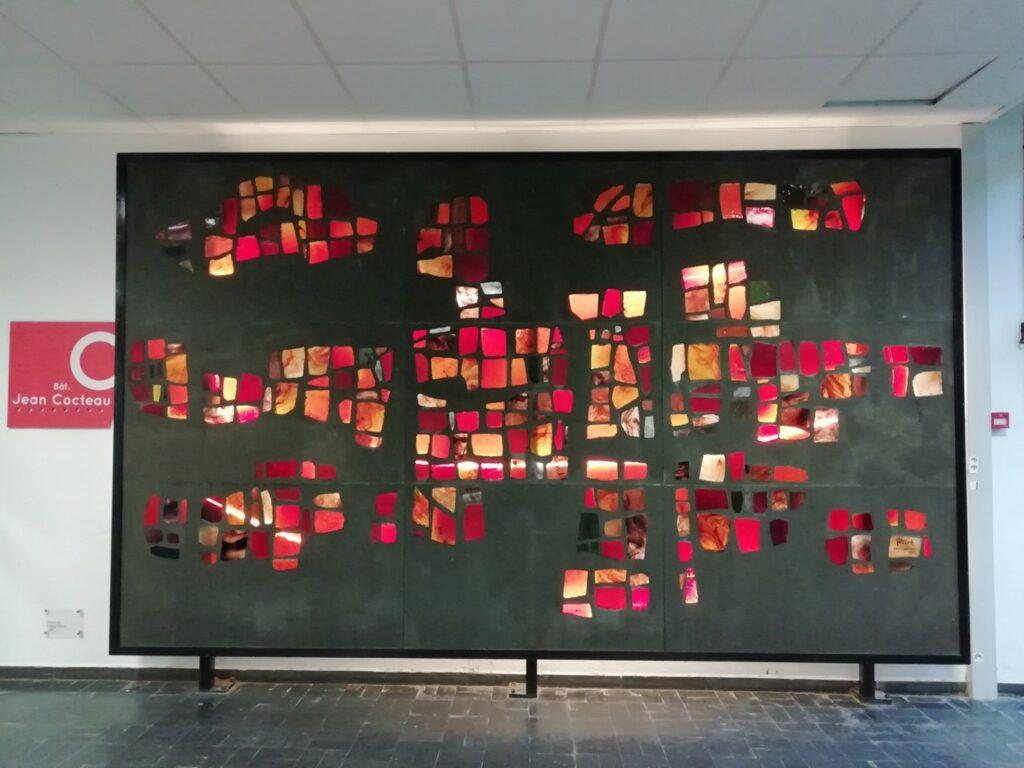
Constantly seeking new expressive means, he soon moved towards a coloured abstraction reminiscent of stained glass through its fragmentation of planes and light. He received around ten public commissions under the “1% for art” scheme, allowing him to explore other artistic forms. At the Crusem primary school in Saint-Avold (Moselle), for example, he designed a concrete-block sculpture in 1966. He devoted himself increasingly to large-scale architectural decoration using a variety of techniques. His earliest works were designed for Protestant temples and churches in eastern France, such as the glass slabs he created for the Protestant church in Ostheim (Haut-Rhin), rebuilt by Georges Hirlemann and René Schmidt between 1958 and 1960. The latter, then regional architect for historic buildings in Lozère, facilitated the artist’s access to commissions in the Languedoc-Roussillon region. In this context, Pillods produced a glass wall for the Protestant house of Lazaret in Sète (Hérault) and stained-glass windows for the temple in Vialas (Lozère) between 1960 and 1967. During the same period, he created two large panels for the Faculty of Letters in Montpellier, which he called “resin tapestries and glass slabs”. He did not consider them to be “stained glass” in the traditional sense. In order for relief and opaque material to acquire graphic meaning, the glass was embedded in a polyester resin support hand-poured by the artist. These works were conceived as sculptures: both sides were treated in a complementary yet distinct manner, with varying forms and transparency effects. Each rectangular panel (2.5 × 3.7 meters) consists of nine modules inlaid with translucent blocks forming an abstract composition independent of any structural framing.
The biblical adventure
In parallel, in the years following the war, his relationships with young pastors of the Lutheran Church gave him the opportunity to develop a visual interpretation of the biblical text. Around Pastor René Lovy, a team for pedagogical reflection and spiritual research was formed, this team included Jacques Lochard, Daniel Louys, Jacques Lugbull, Daniel Mauer and Maurice Sweeting. The biblical and theological discussions surrounding the project guided Pillods in his work, leading him to produce highly purified drawings with restrained lines. His aim was to strike the eye in order to lead viewers to the heart of Scripture.
In 1949, Pillods illustrated René Lovy’s work Sanctuaires montbéliardais, published in Strasbourg by Oberlin. The same year saw the publication of an illustrated volume of Old Testament pericopes issued by the Sunday School Society (SED), entitled The People of God.
Following its success, the following year Pillods published a more personal album entitled Images of the Old Testament, with a preface by the renowned poet Pierre Emmanuel (1916–1984). The artist was introduced to him through Jean Gastambide, a Reformed pastor in Neuilly-sur-Seine and a friend of his wife. Marked by the Resistance, the poet developed a biblically inspired body of work exploring the contradictions of human nature. In his preface he wrote:
“Ô Protestant breaker of images! You sensed that the beauty of the Holy Book, disguised for two thousand years by aesthetic embellishment, rejects all the ornaments with which art has sought to adorn it […] Lines; nothing more. When I first saw your book, I understood the spiritual discipline it imposed upon you: it was dictated by faith, which burns away all that is not itself. Can one speak of a style of faith? Your illustrations of the Bible prove it […] Infinite height, suggested by the whiteness of the page: perspective rising towards the sky, the sky descending perpendicularly upon the earth. Theologians will call it vertical theology. Perhaps so: but here man regains his stature; God entrusts him with the charge of the firmament. Uprightness is the sign of divine will upon man: all your images bear witness to this, fragments of the dialogue between man and heaven […]”
Images of the Gospels
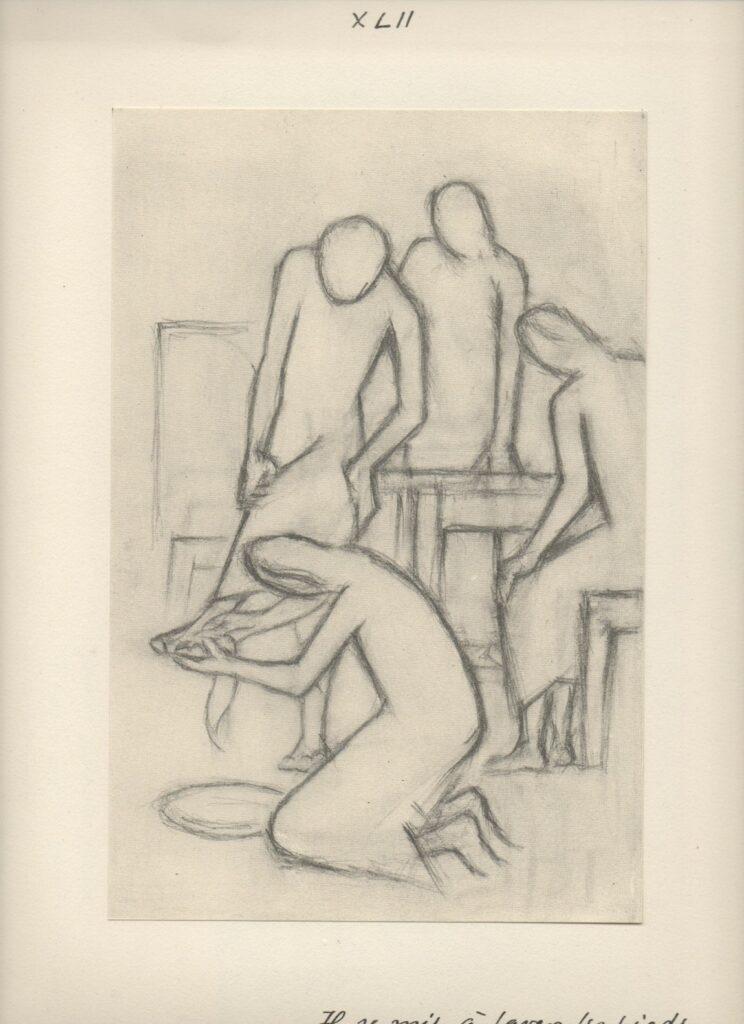
In 1954, Images of the Gospels was published. Once again prefaced by Pierre Emmanuel, the album brought together 56 plates. Reflecting on this five-year project, Pillods wrote: “These drawings seek to convey, with minimal lines, the essence of certain biblical passages whose content and movement had struck me, deliberately setting aside any commentary that might weaken them.”
Each scene in Images of the Gospels is numbered in Roman numerals handwritten at the top centre of the page. At the bottom appears, in cursive script, the biblical verse illustrated, with the precise reference. The translation used is not specified. The plates are organised into four main sections, punctuated by three longer handwritten Gospel passages. Plates I to IX cover the period preceding Jesus’ ministry, drawing on all four Gospels. The sequence concludes with the Sermon on the Mount, the Beatitudes according to Matthew 5:3–8. Plates XIII to XXIII cover Jesus’ teachings, punctuated by the Lord’s Prayer (XXIV) according to Matthew 6:9–13, continuing through to the Passion (XXV–XLII). The meal at Bethany (Matthew 26:7) precedes the Last Supper (XLI), presented according to the Matthean tradition: “Jesus took bread, and after giving thanks” (Matthew 26:26). This is followed by the Washing of the Feet (XLII), with strong emphasis on the meaning of “sharing with me” (John 13:8b), communion with Christ. The sequence continues with a contemplative pause provided by John 13:34–35, the commandment of love, leading into the Passion, death and Resurrection (plates XLIV–LV). The final section concludes with the Ascension (LVI), drawn from Luke 24:54 and Mark 16:19, marking the end of the appearances and the beginning of the mission. The three handwritten texts punctuating the stages of Jesus’ life form milestones in a journey of faith: from the repeated “Blessed are…” of the Beatitudes, through the invocation of “our Father”, to the culmination in the commandment of love. Within this dynamic are placed Bethany, the Last Supper and the Washing of the Feet, understood as interpretative markers of the death and Resurrection of Christ. The whole thus reads as a visual exegesis, an interpretation that is not scholarly but personal and existential, in which episodes are selected and structured by the artist. In this sense, Images of the Gospels is a genuine confession of faith.
Meditation on the biblical text profoundly shaped Pillods’ art and spirituality. Constantly in search of meaning, he particularly favoured the prayer of the father of the sick child addressed to Jesus: “I believe; help my unbelief” (Mark 9:24).