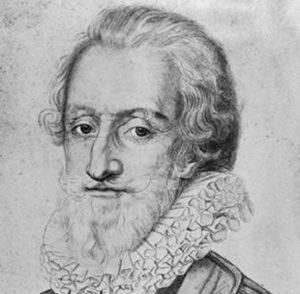
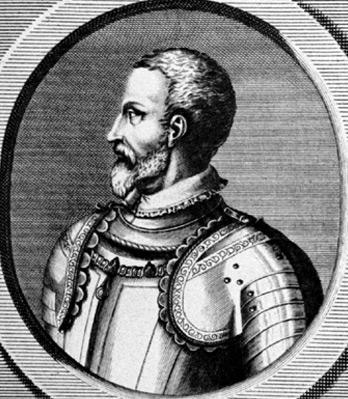
The House of Guise, Dukes of Lorraine, oppose the Reformation
Up to the sixteenth century, Lorraine was torn between France, Burgundy and the Holy Roman Empire. It was only in 1532 that Charles V recognised the Duchy of Lorraine as a “free and non-incorporable state”.
In 1552, Henry II seized the Three Bishoprics: Metz, Toul and Verdun.
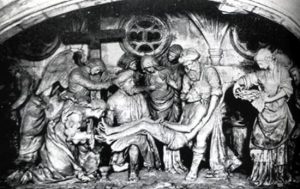
A Protestant sculptor, Ligier Richier

In Saint-Mihiel, around 1543, the schoolmaster Jacques Chobard read and commented upon the Bible. He was burned alive. The sculptor Ligier Richier and several inhabitants of Saint-Mihiel addressed a petition to the Duke of Guise, requesting the right to live in “Christian liberty”. It was refused, and they were compelled to take refuge in Metz, then under French authority, like Toul and Verdun.
At Jametz, a fortified town between Sedan and Montmédy, a Reformed service was held, where the children of Protestant families from Metz were brought for baptism. Besieged by the forces of the Catholic League in 1589, the garrison was forced to capitulate. The ruins of the castle still remain on the road to Verdun.
Metz, an episcopal city

It opened itself to the ideas of the Reformation as early as 1523–1525. Their propagator, Jean Leclerc, was burned alive there on 29 July 1525. Guillaume Farel and Pierre Toussain came in person to support the movement. The Augustinian friar Jean Chatelain, who preached an evangelical Lent, was burned at Vic-sur-Seille, the bishop’s residence. Jean Le Fèvre, previously branded with a red-hot iron at Meaux for acts of iconoclasm, was likewise condemned and died in the flames whilst reciting Psalms. In 1542, Farel returned to Metz to organise the Church along Reformed lines. He was forced to flee after an attack at Gorze during an assembly at which he administered Communion. Protestants enjoyed no respite until France regained control of the city in 1552. Worship was authorised in 1561, and Henry of Navarre granted the Reformed Church official recognition.
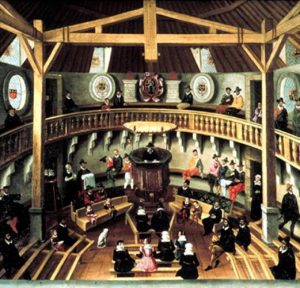
It developed around successive places of worship and established some twenty schools.
By around 1620, it was estimated that half the city had adhered to the Reformation.
In 1648, the Treaty of Westphalia definitively attached Metz to France, and pressure upon Protestants intensified.
At the Revocation, Louis XIV granted the inhabitants of Metz ten months to convert.
The dragonnades did not begin until August 1686. The Reformed either abjured or fled to the Refuge. The deportations of 1687 brought the resistance of the remaining leaders to an end.
In the eighteenth century, the “New Converts” were harassed, though as Protestant craftsmen were economically necessary, periods of respite did occur.
In 1760, worship resumed at Courcelles-Chaussy.
In Metz itself, a Protestant community met in secret around 1770. In 1803, there were still 800 members, a Swiss pastor and an oratory.
In the former département of the Meurthe, approximately 1,500 Reformed believers were spread around Nancy, Sarre-Union and Sarrebourg.
In the Vosges, there were only about one hundred Reformed at the beginning of the nineteenth century.