
Treasury and then Royal Residence
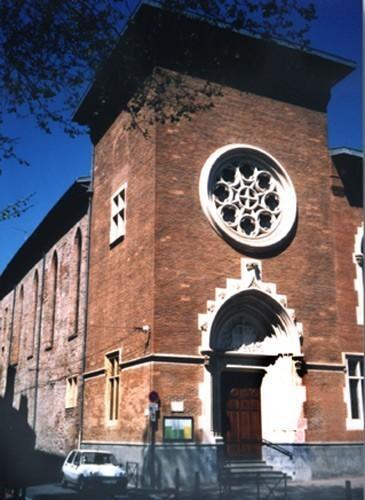
Following the death of the last Counts of Toulouse, Alphonse of France and Jeanne of Toulouse, in 1271, King Philip III “the Bold” took possession of the county.
The royal treasury building was immediately constructed, covering a vast area of 2,500 square meters. It was bounded by the present-day Rue du Languedoc, the Impasse de la Trésorerie, and the Convent of Saint-Antoine du Salin.
The General Treasurer resided there and adjudicated legal cases relating to his administration. A 20 meter-high square tower dominated the complex: it served as a strongroom for the collection of taxes and the safekeeping of documents relating to the royal domain.
During a visit to Toulouse in 1463, King Louis XI stayed at the treasury for two months.
Convent of Religious Sisters
In 1792, during the Revolution, the buildings and gardens of the treasury were sold as national property.
In 1807, the Sisters of Charity of Notre-Dame, established in the Rue Larrey until the Revolution and driven from their convent, obtained authorisation to reconstitute their community. They purchased the convent and church of Saint-Antoine du Salin, together with the adjoining former treasury.
However, in 1904, under the government of Émile Combes, their congregation was dissolved by the State and their property sold in eight separate lots.
Conversion into a Protestant Church
Two Protestant merchants then purchased the former Treasury building, covering an area of 850 square meters, and in 1908 transferred it to the Reformed Church association. The Protestant architect Léon Daures (1877–1951) restored and adapted the building in a neo-Gothic style, reusing certain medieval elements, including part of the original masonry. The decoration was executed by the glassmaker Calmels, the mosaic artist Laplana, and the sculptor Alexis Mauguet. The first service was conducted by Pastor Edmond Lengereau (1864–1942) in November 1911.
Listed as a historic monument in 1990, the Temple du Salin remains a place of Reformed worship.
