Toulouse
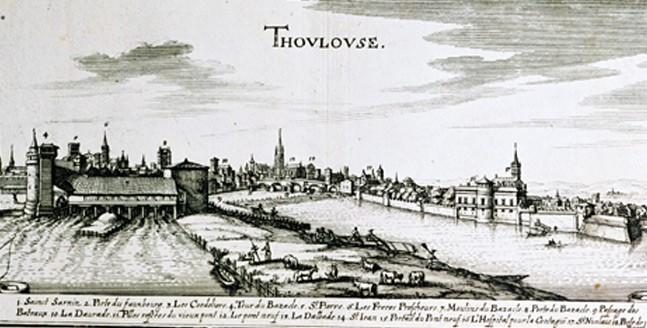
The capital was a stronghold of Catholicism; yet, from the sixteenth century onwards, Protestant communities were established in its surroundings: in the former County of Foix, at Le Mas-d’Azil, Revel, and Saverdun; further north, more densely, at Castres, Mazamet, in the “Montagne du Tarn,” and in the Gers at Mauvezin, as well as in Béarn.
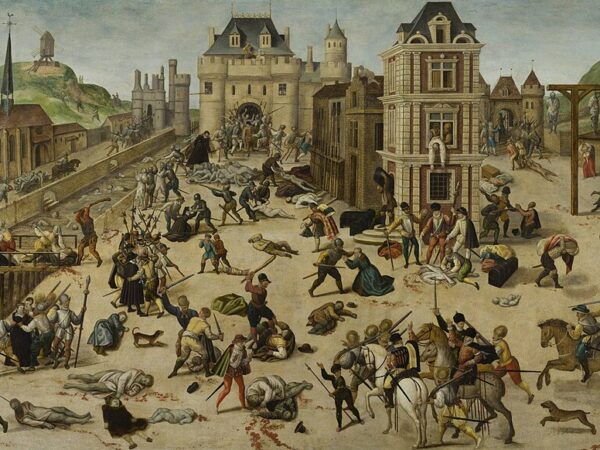
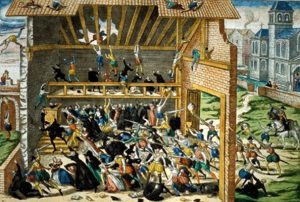
From 1558 onwards, churches were founded, though a severe repression in 1562, followed by the massacres of St Bartholomew’s Day, considerably reduced their numbers. The Hôtel d’Assézat, now the Bemberg Foundation Museum, recalls its Protestant owner, a Capitoul (municipal magistrate) of the city, enriched through the trade pastel dye.
In the seventeenth century, the Protestants of Toulouse assembled at L’Isle-Jourdain, and later at Le Portet, to the south of the city.
In 1683, the lawyer Claude Brousson sought to rally around his project those who wished both to serve God and the King.
Jean Calas
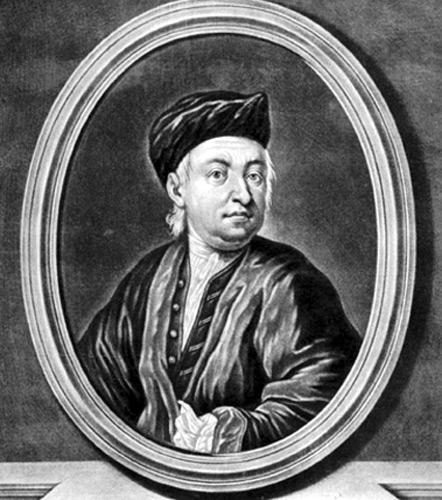
Jean Calas, a Protestant merchant of Toulouse, accused of murdering his son in order to prevent him from abjuring, was broken on the wheel in 1762. Voltaire undertook his defence: this was the celebrated “Calas Affair,” which contributed to the rehabilitation of the condemned man in 1765. The Calas house is located at 50 Rue des Filatiers.
Le Mas d'Azil and Ariège

Le Mas-d’Azil was the centre of a Protestant community, largely rural, though also comprising a number of bourgeois and gentleman glassmakers. In 1625, the cave of Le Mas-d’Azil, extending some 400 meters and which had formerly sheltered the Cathars, served as a refuge for Protestants during a severe siege by the royal army of Louis XIII, which ultimately recaptured the town.
At Le Carla was born, in 1647, the Protestant philosopher Pierre Bayle, renowned for his advocacy of freedom of conscience. A museum is now established in his birthplace.
After the Revolution, some 7,000 Protestants remained in Ariège, around Le Mas-d’Azil and Saverdun-Mazères.
Castres and the Tarn
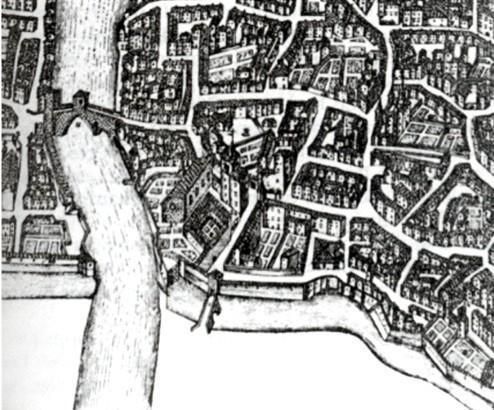
From as early as 1530, Castres embraced the Reformation and became a place of security. A Protestant college was founded there in 1574.
Claude Brousson resided in the town and organised the response of the persecuted Church.
At Castelmoutou, on the lintel of the gateway of the former women’s prison, one may read:
“We love God; He will deliver us.”
The Temple of Castres is the former chapel of the Capuchin convent (seventeenth century), assigned to Protestants after the Revolution.
In the seventeenth century, 20,000 Protestants were distributed among the towns of Roquecourbe, Réalmont, Montredon, Vabre, Castelnau, Brassac, Viane, Lacaune, Anglès, and La Bastide-Rouairoux.
The Monts de Lacaune

They rank among the principal centres of the Reformed faith.
At Pierre-Ségade, a suburb of Viane, a clandestine assembly was held after the St Bartholomew’s Day massacres.
After the Revocation, several assemblies were likewise held in the mountains.
In 1689, the meeting of Saint-Jean-del-Frech was surprised by the King’s dragoons. Fifty Protestants were massacred, and their preacher, Corbière de la Sicarié, was slain at the Pierre-Plantée near Castelnau-de-Brassac, where Protestants have since gathered each year on the fourth Sunday of August. A monument commemorates this tragic massacre.
Ferrières
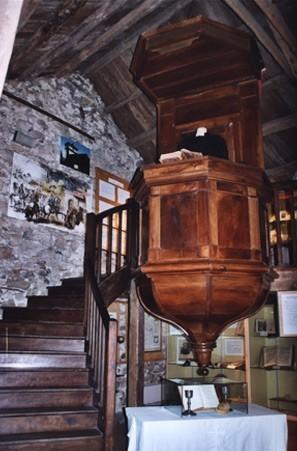
At Ferrières, the Museum of Protestantism in Haut-Languedoc preserves the memory of this region marked by the Reformation and the prolonged resistance of the seventeenth and eighteenth centuries.
Mazamet and Puylaurens still numbered 10,000 Protestants in the mid-seventeenth century.
Yet after the Revolution, only 18,000 Protestants remained in the whole département of the Tarn.
Montauban and its Region
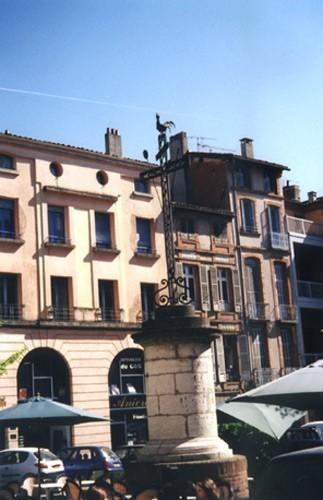
In 1570, following the Peace of Saint-Germain, Montauban became a Protestant stronghold.
In 1600, one of the most renowned Protestant academies was founded there; some of its buildings survive in the Rue Léon de Malleville. Two temples existed in the seventeenth century, on the present-day Place du Théâtre and Place du Coq.
In 1621, Montauban, supplied with elite troops by Henri de Rohan, withstood for two and a half months the army of Louis XIII.
In 1622, the fortified town of Nègrepelisse was taken by the royal army, and its inhabitants massacred on the orders of Louis XIII.
Repression struck Montauban well before the Revocation.
Repression struck Montauban long before the Revocation

In 1659, the Academy was transferred to Puylaurens (in the present département of Tarn), following a clash between Catholic and Protestant students.
In 1661, 4,000 soldiers were quartered in Montauban to repress resistance.
In 1664, the first temple was razed, and the second destroyed in 1683.
In 1793, the chapel of the former Carmelite convent became a temple.
In 1803, 12,000 Reformed believers were recorded in Tarn-et-Garonne.
Cahors and the Lot
Around 1560, a nascent church at Cahors was annihilated by the massacre of half of its Protestant members (some fifty Reformed believers). In the seventeenth century, approximately 4,500 faithful were counted around Saint-Antonin (now in Tarn-et-Garonne), Cajarc, Cardaillac, La Tronquière, and Saint-Céré.
Agen and the agenais

Agen embraced the Reformation as early as 1536. The church of the Jacobins and the convent served as refuges for suspect scholars. Around 1560, some 6,000 Huguenot faithful were counted there. The Wars of Religion proved particularly bloody, and the Edict of Nantes forbade the exercise of Protestant worship in the town.
At the Revocation in 1685, the Marquis de Boufflers, “General of the Dragonnades,” subdued the Agenais.
The present Hôtel de Ville of Agen served as the law courts in the seventeenth century, where many Protestants were condemned to death.
In 1751, clandestine assemblies resumed in barns.
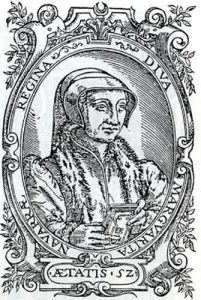
Nérac, centre of the Duchy of Albret, attached to France only in 1607, was one of the great capitals of Protestantism. Marguerite of Angoulême, later Queen of Navarre, established her court there, where she died in 1549.
In the château, of which the northern wing remains, she received Lefèvre d’Étaples, who died there in 1536. She granted asylum to illustrious reformers who could no longer reside in France without danger.
Calvin resided there near the Pont Vieux.
Théodore de Bèze lived in the Rue Pizoque and preached at Agen.
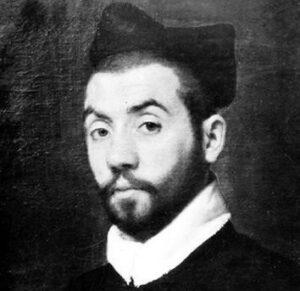
Clément Marot was likewise among the guests of Marguerite of Navarre, a woman of letters and intellect.
It was at Nérac, in 1579, that Henry III of Navarre, the future Henry IV, signed with Catherine de Médicis the treaty of peace ending the sixth War of Religion.
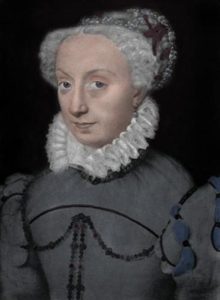
Jeanne d’Albret, daughter of Marguerite of Navarre, wife of Antoine de Bourbon and mother of Henry IV, lived at Nérac, and the population, following her example, largely embraced the Reformed religion. After the Wars of Religion, a strong Reformed nucleus developed around Nérac, Clairac, and Tonneins.
In 1621, Clairac offered fierce resistance to the troops of Louis XIII, determined to subdue the Huguenots.
In 1803, only 15,000 Reformed believers remained in the whole of Lot-et-Garonne.
Mauvezin and the Gers
To the north-west and west of Toulouse, on the borders of Armagnac, several Protestant communities existed from the sixteenth century at Mauvezin, Puycasquier, Mas-Grenier, and L’Isle-Jourdain, which gathered around 2,000 faithful.
In the seventeenth century, 243 Protestant families were still recorded at Mauvezin, which retained an oratory in 1803. By the end of the nineteenth century, only 320 faithful remained.
Rodez and the Aveyron
From the sixteenth century, Reformed communities appeared at Millau, Saint-Affrique, Camarès, Saint-Jean-du-Bruel, and Villefranche.
At Millau, after St Bartholomew’s Day, the decapitated Reformed party held its first political assembly. This town, three-quarters Protestant, maintained its Protestant college until 1663. Yet when the dragoons reached the city gates on 11 September 1685, its inhabitants abjured en masse.
At Saint-Affrique, the Protestants succeeded in 1628 in repelling the royal army commanded by Henri II de Bourbon, Prince of Condé. In 1734, after the Revocation, a Desert assembly at the rock of Cailux was surprised; five persons were condemned to the galleys or to life imprisonment.
At the restoration of freedom of worship at the close of the eighteenth century, only 5,000 Reformed believers remained in Aveyron.