Champagne
In the sixteenth century, entire villages, such as Heitzl-le-Maurupt and Vieil-Dampierre, together with their peasants, merchants, and lords, embraced the new religion. Towns such as Troyes, Wassy, Vitry-le-François, and Chaumont were provided with ministers.
Troyes was won over to the Reformation as early as 1535 and had its Reformed martyrs in 1546.
Nevertheless, the proximity of the House of Guise upon their lands in Lorraine, together with the vigilance of the archbishops of Reims, among them Charles de Guise, the future Cardinal of Lorraine, served to limit the expansion of the Reformation.
At Reims, a number of Huguenots assembled clandestinely in the chalk cellars (Crayères), and in 1561 Théodore de Bèze met there the Huguenot of Brancourt and the Cardinal of Lorraine at the pavilion of Muire, now situated in the Rue Linguot, near the Hôtel de Ville.
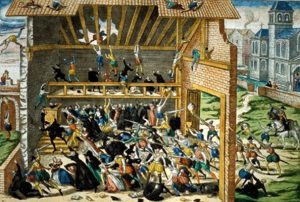
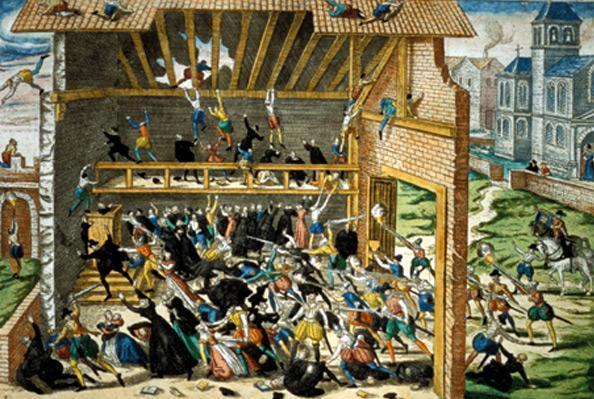
On 1 March 1562, at Wassy, the Duke of Guise permitted his troops to massacre a Huguenot congregation gathered for preaching in a barn, which has since become the Protestant Museum of the Grange of Wassy.
The Massacre of Wassy marks the beginning of the first War of Religion.
At Châlons-sur-Marne, around 1591–92, worship took place in the cellars of the house of M. Brichot, at the corner of the market square. Henry IV attended there on 22 July 1592, during his reconquest of the kingdom. The former Protestant cemetery was located in the Rue aux Vaches (present-day Rue Saint Éloi), at the level of the Rue des Vieilles Casernes.
Within the diocese of Reims, it was only at Ay-en-Champagne that worship was authorised by the Edict of Nantes. The Cour du Prêche preserves the memory of this.
The chapels of châteaux hosted acts of worship

Certain castels hosted worship in their chapels: in the Marne, at Bordes, 6 km from Sézanne, and at Saint-Mards-en-Othe, a Huguenot stronghold from 1568; a Huguenot cross appears in the commune’s coat of arms.
Ardennes
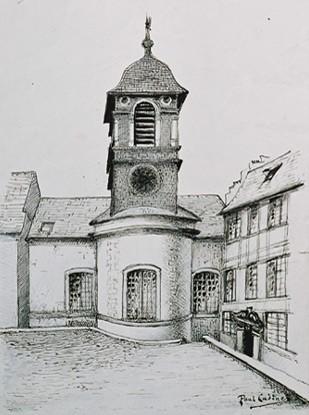
In the Ardennes, the Reformation took root along what is now the boundary of the département of Aisne, at Rocroi (Bourg-Fidèle), Mézières, and Imécourt.
In the Aisne, around 1525, peasants who had gone to reap near Meaux brought back Reformed ideas to Landouzy (near Vervins), which became, during the League, a small Protestant stronghold. Owing to the Croy family, a Reformed church was established at Montcornet and Parfondeval, and subsequently at Chauny.
From 1570 onwards, Protestant families from Laon emigrated to Geneva, a place of refuge.
The independent principality of Sedan adopted Protestantism in 1562. Its lord, the Duke of Bouillon, summoned the minister Guy de Brès, apostle of the Belgian Netherlands. Together with his wife, known as the Regent, he authorised both Catholic and Protestant worship, a form of simultaneum, within the Church of Saint-Laurent, now destroyed. In 1579, the Regent founded a Protestant college. Her daughter Charlotte, was married to Henri de La Tour d’Auvergne, Viscount of Turenne and future Marshal of France, who caused a temple to be built which was later transferred to the Catholic Church: this is the present Church of Saint-Charles, which, during the Revolution, served as the cathedral of the Ardennes and as a Temple of Reason.
The Protestant Academy of Sedan

In the seventeenth century, Henri de La Tour d’Auvergne established at Sedan a military school and an Academy which attracted numerous foreign students and teachers. Pierre Dumoulin, Pierre Jurieu, and Pierre Bayle were among its professors. The Academy was closed in 1681, though several buildings remain today: the Collège in the Rue du Mesnil, and the military school at the house known as the “Gros chiens,” upon which biblical inscriptions are still visible. The Reformed church of Sedan had three ministers and gathered between 5,000 and 6,000 Protestants.
At the time of the Revocation, the Reformed of Sedan refused to convert. In November 1685, Louvois dispatched 300 cavalrymen and 17 companies. Resistance lasted five or six days, after which all yielded.
Sedan thereafter experienced clandestinity, imprisonment, the galleys, but also worship in the woods. In 1779, a measure of toleration emerged, and an oratory was opened in the district of Fond de Givonne, where worship was conducted until the Reign of Terror.
In 1802, the Reformed of Sedan were granted the chapel of the former convent of the Daughters of the Propagation of the Faith, where young Protestant women had been confined in order to secure their conversion.
Vitry-le-François and Pierre Jurieu
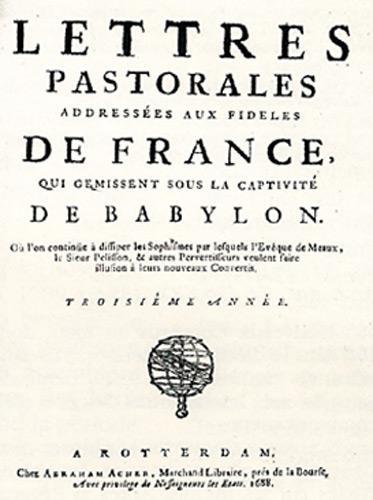
In the seventeenth century, there also existed an important Protestant church at Vitry-le-François, with two ministers and 2,000 faithful. The temple was then located at Frignicourt, on the site of the present SNCF station. The minister Pierre Jurieu published there in 1673 his celebrated Treatise on Devotion. The mathematician Abraham de Moivre, a member of the Royal Society of London, was likewise a native of Vitry-le-François.
The Protestant community of Champagne, also spread across smaller towns (Heiltz-le-Maurupt, Nettancourt, Wassy, Bar-sur-Seine), numbered approximately 9,000 members.
The Revocation occasioned a considerable emigration towards neighbouring countries.
The symbol of this tragic period may be found in the person of Louis de Marolles, born in 1629 at Heiltz-le-Maurupt, receiver of the bailiwick of Sainte-Ménéhould, who refused to abjure despite the entreaties of Bossuet and ended his days as a galley slave in 1692. During the Desert period, Claude Brousson and Gardien Givry came to hold assemblies in Champagne.
Yet, when freedom of worship was restored after the Edict of Toleration (1787), there remained no more than a few dozen scattered Protestants.