Montpellier
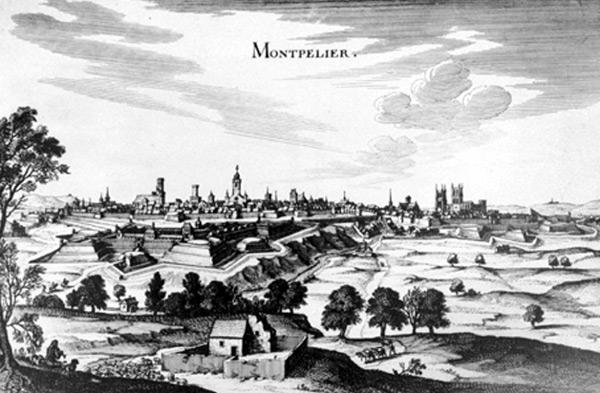
From the beginning of the sixteenth century, the doctrines of the Reformation reached Montpellier, particularly within medical circles. A church was established there in 1560.
Armed conflicts set Catholics and Protestants against one another; religious buildings were destroyed, and Saint Peter’s Cathedral suffered damage, though the St Bartholomew’s Day Massacre (1572) claimed no victims there.
Granted the status of a Protestant stronghold in 1577, the city was taken by Louis XIII in 1622, who there confirmed the religious clauses of the Edict of Nantes.
From 1624 to 1627, the present lycée was built to serve as a barracks and later as a prison for Protestants. Claude Brousson in 1698 and Pierre Durand in 1732 were executed on what is now the Esplanade.
On the site of the present prefecture once stood the Great Temple, built in 1583 and demolished in 1682.
The Arc de Triomphe of the Peyrou
The Arc de Triomphe of the Peyrou, erected to the glory of Louis XIV between 1691 and 1693, commemorates the destruction of heresy.
In the mid-eighteenth century, worship was tolerated and held at the Mas de Merle. From 1772 to 1792, the officiating minister was Pastor Jacques-Antoine Rabaut-Pomier, second son of Paul Rabaut.
After the Revolution, the Reformed acquired in 1803 the former chapel of the Cordeliers of the Observance (now a performance hall in the Rue de Verdun), which they converted into a temple.
Around Montpellier
To the west of Montpellier, Reformed communities existed from the sixteenth century at Pignan, Cournonterral, Cournonsec, Montbazin, Villeveyrac, Montagnac, and Béziers, numbering some 450 faithful in the seventeenth century; further north, Bédarieux and Faugères formed isolated Protestant communities.
At Saint-Pons, the Revocation was enforced with moderation by the bishop of the diocese. Throughout the hinterland, the lawyer Cambolive supported the Protestant faith after the destruction of the temple in Montpellier ; he was condemned to the galleys, though his sentence was later commuted to exile.
At Sète, in 1710, foreign troops landed to support the Camisards, long awaited by them. They held their position for four days before re-embarking, having spread panic between Sète and Agde.
In 1802, of the 18,000 Protestants in the Montpellier colloquy, 13,000 still remained in the Hérault, including 3,000 at Ganges and 2,500 at Marsillargues and Lunel.
Pyrénées-Orientales
Roussillon remained largely closed to the Reformation. At Perpignan stands the sole Protestant place of memory, the Castillet, where Huguenots were imprisoned at the time of the Revocation.