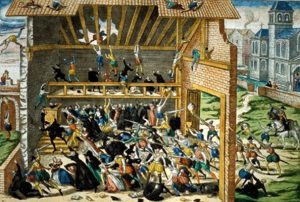
Lower Normandy
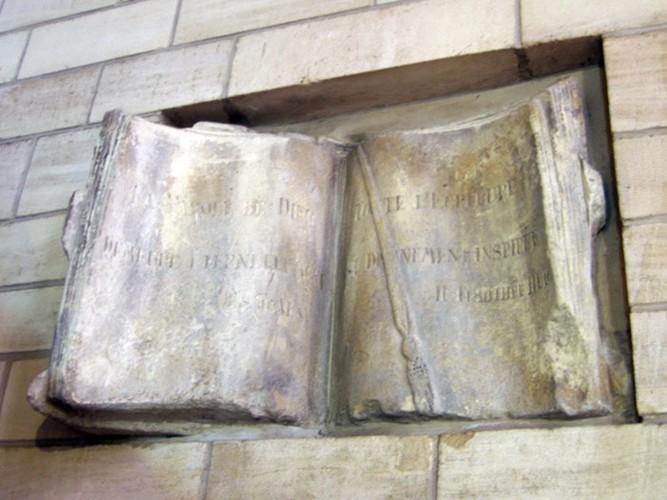
At Caen (Calvados), in the new temple inaugurated in 1958 (which replaced the temple in the Rue de Géole, destroyed during the bombings of 1944), one may see a stone Bible discovered intact among the ruins of the former temple. On the left-hand page is inscribed: “The word of God endureth for ever”, and on the right: “All scripture is given by inspiration of God” (I Timothy).
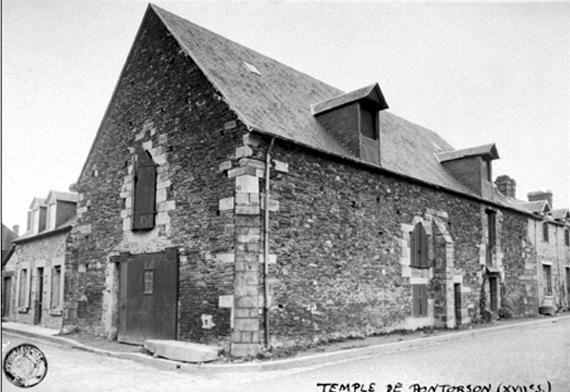
In the department of Manche, the town of Pontorson—the chief town of the canton—took part in the Wars of Religion and was assigned to the Calvinists as a place of safety. Its temple (also called “the preaching house”) was converted into a barn.
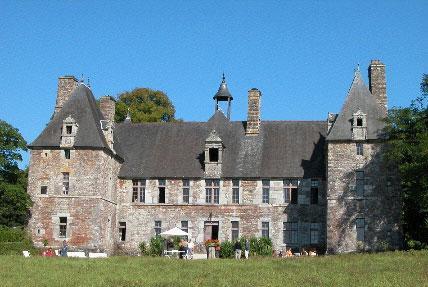
Pontorson, like Ducey, was a seigneurial church placed under the protection of the Montgomery family. Likewise, that of Cerisy came under the protection of the Richier family; the seigneury of Cerisy had passed to the Richiers in the fifteenth century.
A first temple at Cerisy dates from 1561, but it was closed in 1584 by order of King Henry III.
Following the Edict of Nantes, and until its Revocation, the church at Cerisy was very active, gathering together the Reformed of the region, numbering approximately three hundred faithful.
The Château of Ducey, built in 1624 by Gabriel II de Montgomery, lost its temple in 1841.
Upper Normandy
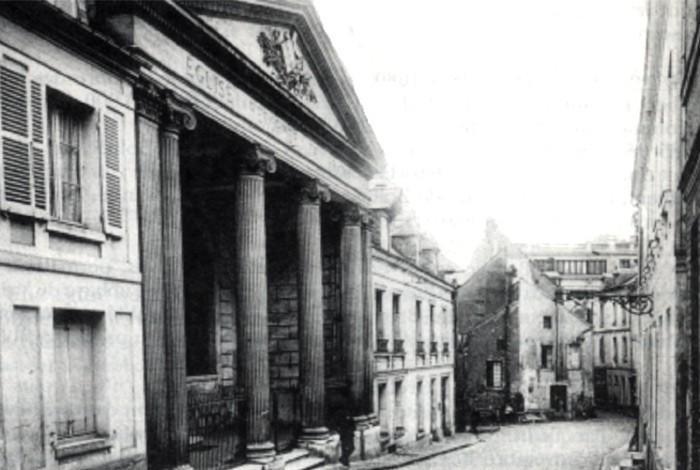
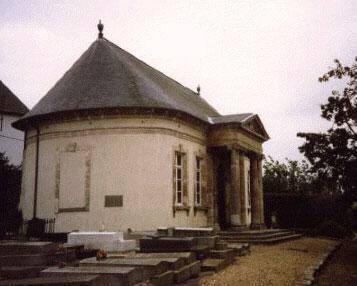
In Upper Normandy, in the department of Seine-Maritime, between Le Havre and Dieppe, three temples still remain, all built following the restoration of worship and the reorganisation of the Reformed Church under the Organic Articles of 1802: Bolbec, Montivilliers, and Luneray.
The temple at Bolbec (Seine-Maritime) was built after the Revolution and inaugurated in 1797, during the Christmas service. The portico, however, was added later, dating from 1877.
Attached to the consistory of Bolbec, the temple of Montivilliers (Seine-Maritime) was built around 1850. Yet the church itself had been founded as early as 1555, its first ministers having come from Geneva.
The present temple of Luneray (Seine-Maritime) was built only in the nineteenth century, like the other two. Nevertheless, it is clear that the Reformed church of Luneray dates back to the Reformation. According to local tradition, it was represented at the first national synod held in Paris in 1559. A first temple was destroyed during the Wars of Religion; a second, built in 1630, was demolished in 1681.
For further information:
Apply to Madame Geneviève Cornevin,
General Secretary of the Société d’Histoire du Protestantisme en Normandie
4 rue Auguste Lechesne, 14000 Caen
Publication: Le Souvenir huguenot (published since 1988)