Protestant Goldsmiths in the Seventeenth Century
Protestant goldsmiths developed their craft out of loyalty to the sovereign, but also because their religion distanced them from the production of liturgical objects. They specialised in jewellery and ornamental design. Their works often remained anonymous, as at the time “goldsmiths in gold” were not required to sign their creations. It is now established that the gold chest long attributed to Anne of Austria was delivered to Louis XIV in the spring of 1676, “to contain all the adornments”, that is to say the jewels with which the king’s court costumes were decorated.
An Exceptional Artist
It was Jacob Blanck, or Jacques Blanc, an obscure Protestant journeyman specialising in gold-work, who made it, as confirmed by archival records indicating the delivery of gold by Jean Pitan to Jacob Blanck for the creation of this piece.
Jacob Blanck, of German origin, has left few traces. He may have been born in Nuremberg or Augsburg, where an eponymous ancestor died in 1680. In 1682 he lived in the Rue Dauphine, in the household of the widow of Abraham Van de Lent, a Protestant goldsmith with whom he remained for nine years. In 1686 he was granted master goldsmith’s letters patent, having abjured Protestantism.
A Unique Object
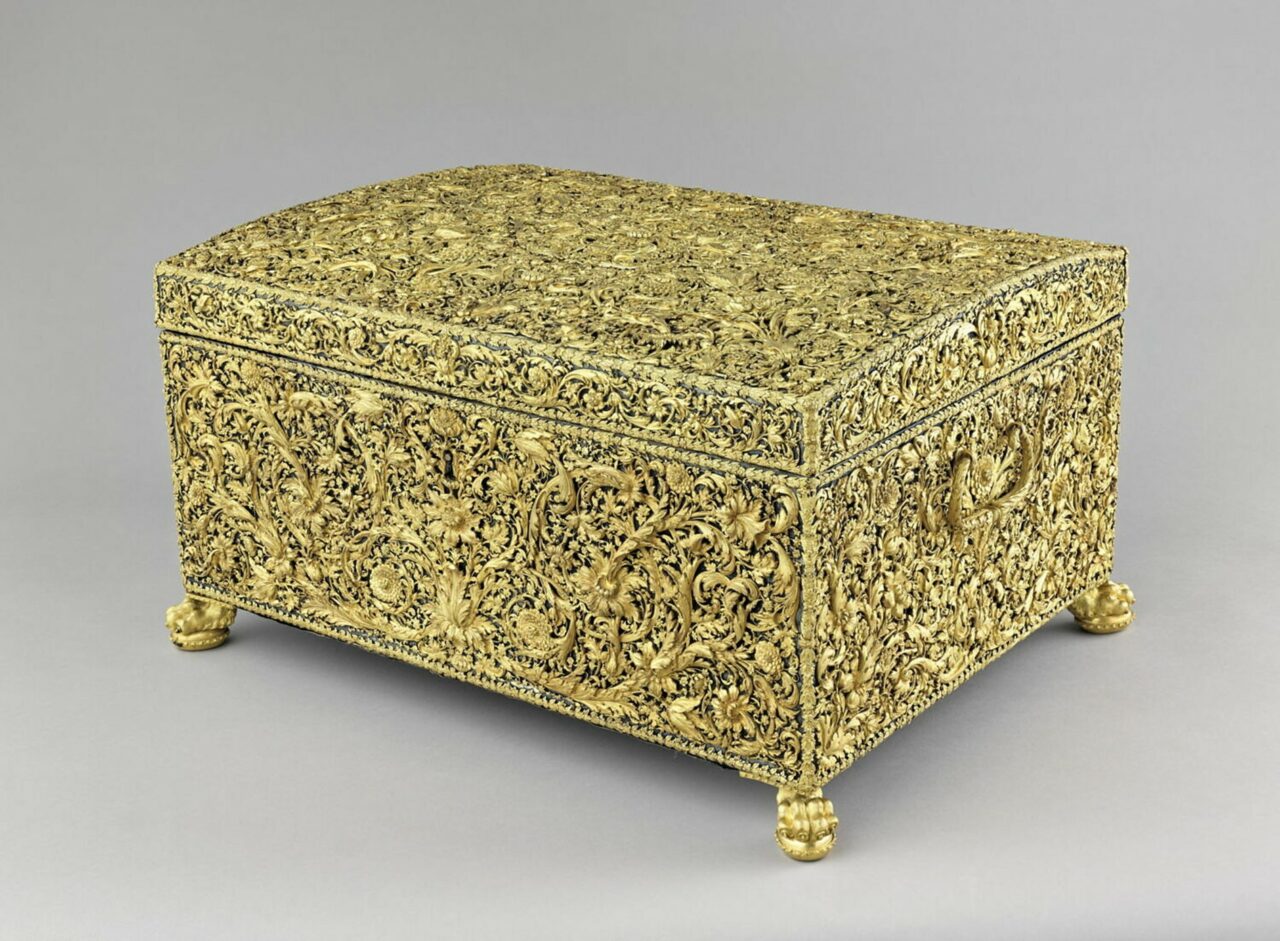
The oak chest, known as the “Anne of Austria”chest , is covered with an openwork gold casing of predominantly floral design. It is composed of five panels of pierced and chased gold, featuring a decoration of large acanthus scrolls interspersed with roses, tulips, zinnias, narcissi, carnations, and lilies, enriched with small vine leaves, blossoms, tendrils, and stems, all arranged in a symmetrical composition. It rests on four solid gold feet in the shape of lion’s paws set upon small pebbles; two lateral handles decorated with foliage allow it to be lifted.
It is one of the rare surviving examples of the splendour of seventeenth-century Parisian gold-smithery. The floral decoration evokes Parisian goldsmith works of the 1660s, while the larger flowers show similarities with engravings from François Lefèbvre’s Book of Flowers, engraved by Balthazar Montcornet and published in Paris in 1635. These engravings incorporate stylised floral motifs close to the work of goldsmiths such as Roberday or Delabarre in the 1640s–1650s. This chest, a unique work of its kind, draws inspiration both from the vegetal style of 1625–1635 and the floral style of the 1660s.