Guyenne
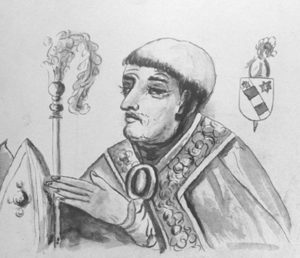
At Bordeaux, the Reformation penetrated relatively late. It spread through maritime exchanges maintained with converted countries, namely Holland and England, but also through the masters of the Collège de Guyenne, particularly Mathurin Cordier, who had been Calvin’s first teacher at the Collège de la Marche in Paris. The masters of the Collège de Guyenne, founded by the Archbishop of Bordeaux and the Jurade in 1533, played a decisive role in this diffusion.
In 1546, Nicole Maurel, a former Celestine monk and regent of the Collège de Guyenne, suffered martyrdom at Saintes.
In the fishing village of Arvert, the former priest Philibert Hamelin organised a church before being put to death at Bordeaux. Thereafter, the Parliament of Bordeaux displayed as much zeal in repressing heresy as that of Toulouse. Nevertheless, the Church of Bordeaux, established in 1560, gathered some 7,000 faithful.
During the St Bartholomew’s Day Massacre, the orders issued from Paris were carried out with severity.
The Fort du Hâ, whose towers still stand today, recalls the memory of Protestants who were imprisoned there, either because they refused to abjure or because they were attempting to flee towards the Refuge.
The Château Trompette, a citadel built by Charles VII after he had expelled the English from Guyenne at the Battle of Castillon (1453), also served as a prison for refractory Protestants. It was demolished in 1818 to create the Place des Quinconces.
The Temple of Bordeaux, known from a 1639 drawing by the Dutchman Van Der Hem, was situated at Bègles, one league from the city. It was demolished on 5 September 1685.
Protestant communities also existed at Bazas, Duras and Meillan.
At the time of the Revocation, the presence in Bordeaux of a strong foreign colony, among whom many were Reformed, limited the repression.
The “new converts” of Bordeaux took care to preserve a church “under the cross”. A colloquy was reconstituted around 1753 by the pastor Grenier de Barmont. The Moravian Brethren exerted their influence upon the city through the German colony.
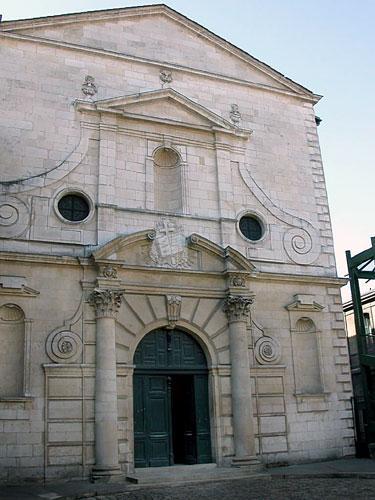
After the Revolution, the former chapel of the convent of the Filles-de-Notre-Dame, responsible for the education of young Huguenot girls, was assigned to Reformed worship: it is the present Temple du Hâ.
Navarre
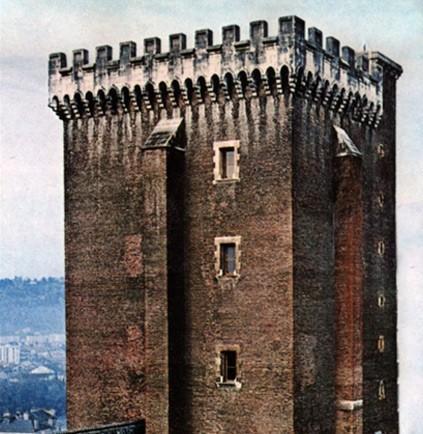
The Reformation was introduced into this region the dominant region of protestantism first through the influence of the Bishop of Oloron from 1536 to 1555, Gérard Roussel, linked with Bishop Briçonnet and Guillaume Farel, then when Marguerite of Angoulême, sister of Francis I, favourably disposed towards the Reformation, married the King of Navarre. If her son-in-law Antoine de Bourbon proved more hesitant, his wife Jeanne d’Albret openly professed the Reformed faith at Christmas 1560. She even instituted a form of simultaneum in the churches of Béarn. Images of saints disappeared from churches; Catholicism became a tolerated minority. Pierre Viret came to found a Protestant academy at Lescar. Jeanne’s son, Henry III of Navarre, later Henry IV, was born at the Château of Pau on 15 December 1553 and spent his childhood at the Château of Coarraze, of which a tower still survives.
In 1569, after the defeat of the Huguenots at Jarnac, Jeanne d’Albret, having withdrawn to La Rochelle, assumed leadership of the resistance against the royal army sent by Catherine de Médicis to “eradicate” Protestantism.
At Navarrenx, the army of reconquest led by Montgomery routed the royal forces. For half a century, Protestantism dominated Béarn.
The Psalms were translated into Béarnais. The Protestant Academy founded at Lescar was transferred to Orthez. Pau, Sauveterre, Nay and Oloron became strongholds of the Reformed faith.
The Edict of Nantes did not apply to Béarn, which remained a sovereign viscounty in 1598. Louis XIII was even obliged to reconquer Pau in 1620, a prelude to the wars of 1621–1629 which curtailed Huguenot power in France.
Béarn
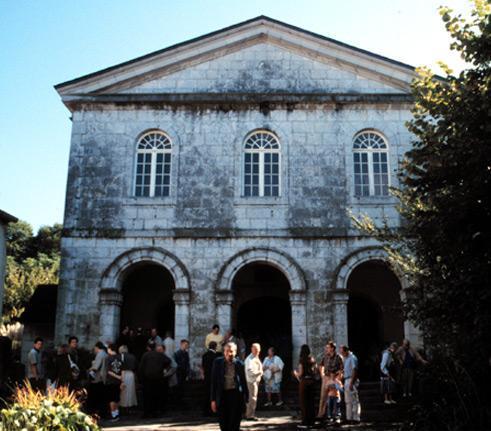
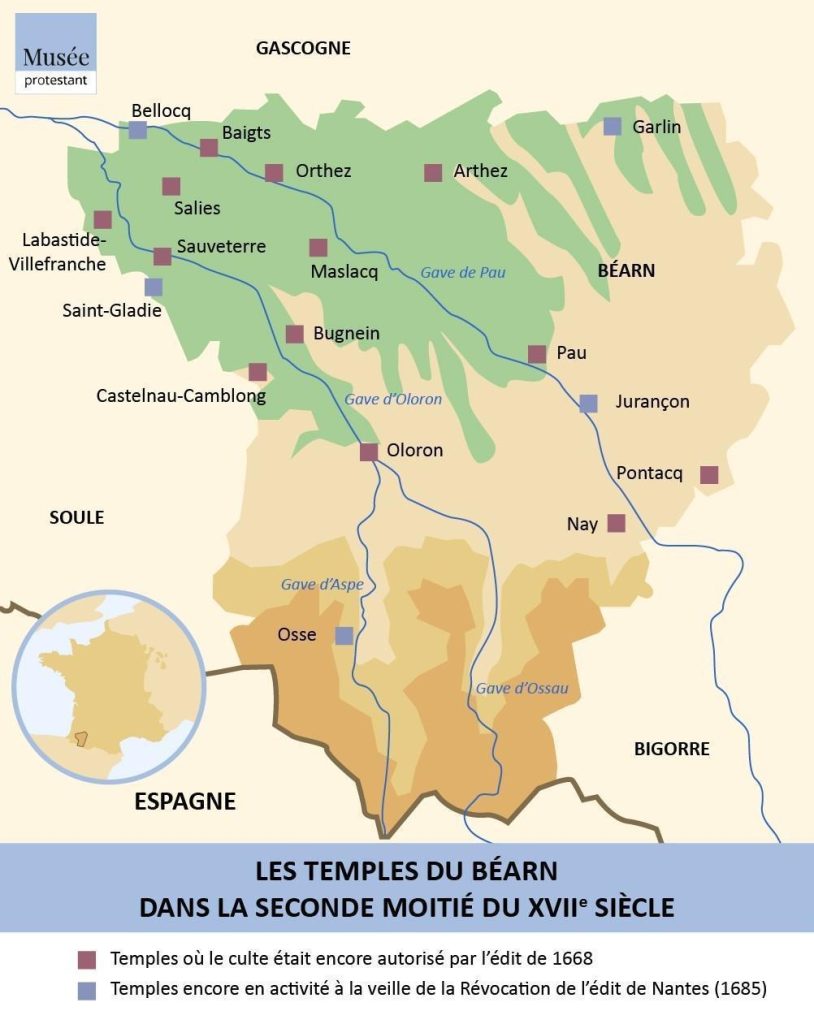
In the mid-seventeenth century, Béarn counted approximately 30,000 Protestants, particularly numerous at Orthez and Sauveterre. One third of the inhabitants of Pau were Reformed, while Salies was almost entirely Protestant.
Prior to the Revocation, the intendant Foucault initiated severe dragonnades as early as the spring of 1685. Temples were destroyed, yet the Bishop of Oloron showed a degree of tolerance regarding the abjuration of the “new converts”.
From 1687 onwards, the singing of Psalms was again heard around Pau. The Reformed gathered in houses and in the surrounding forests. In 1698, Claude Brousson was arrested at Oloron after having presided over two clandestine assemblies at Pau.
From 1750 onwards, Protestantism experienced a revival thanks to the pastor Étienne Deferre.
From 1790, Protestants erected a temple at Orthez, “decorated on the exterior”.
At the time of the Revolution, there remained only 5,000 faithful, chiefly around Salies-de-Béarn and Orthez.
At Pau, the bell tower of the church of Saint-Martin survives, which Jeanne d’Albret had assigned to Protestant worship and where Pierre Viret and Théodore de Bèze preached. Louis XIII restored the church to Catholic use.
Protestant inscriptions in the Aspe Valley:
To the south of Oloron, towards the Aspe Valley, there remain in the villages of Osse-en-Aspe and Hastingues Protestant houses adorned with biblical texts above their doors. Similar inscriptions may also be found at Aydius, though their origin is not established.
At Orthez, the house of Jeanne d’Albret now houses the Museum of Béarnais Protestantism.
Périgord
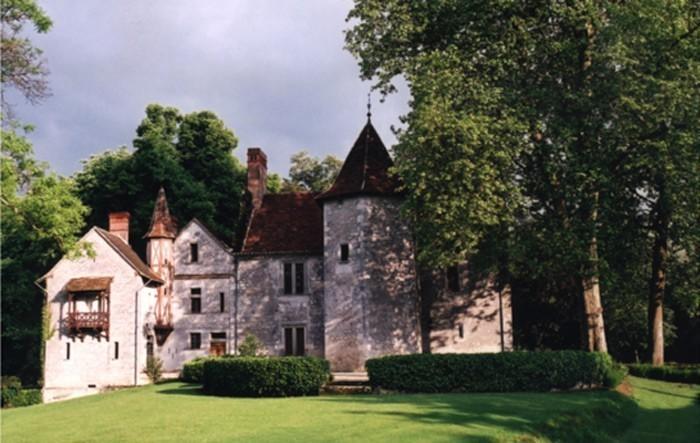
From Libourne to Bergerac, the “Valley” and its surroundings were particularly affected by the Reformation.
Castillon, renowned for its battle, embraced the Reformation as early as 1562. In 1586, the Duke of Mayenne besieged the town, had 22 inhabitants hanged, and ordered the destruction of the town hall.
In the seventeenth century, the great Marshal of Turenne bequeathed 20,000 livres to the poor who would convert to Catholicism. Protestants used the money instead to build a hospital (now the town hall).
The Château de Graveron belonged in the sixteenth century to the Protestant Jean le Berthon, husband of Philippe de Luns. Having taken refuge in Paris, both died in 1557; she was burned alive at the Place Maubert.
Sainte-Foy-la-Grande was converted as early as 1541 by Ayman de la Voye, who was condemned to the stake by the Parliament of Bordeaux. Around 1559, the pastor Sellac corresponded with Calvin and preached at Montségur, Gensac and Pellegrue. In 1578, a national synod was held at Sainte-Foy; a “temple unto the Lord” was erected in 1584. Known as the “Little Geneva”, Henry of Navarre stayed there several times in 1576 and 1588. From the sixteenth-century temple, only the bell remains, now housed in the church.
At the Château du Fauga, between Le Fleix and Port-Sainte-Foix, property of the Bethman family, the first great assembly of the Desert was held on 22 February 1745, gathering 6,000 Huguenots from Bergerac to Libourne.
After the St Bartholomew’s Day Massacre, Bergerac became the intellectual capital of the Protestant world. Richelieu ordered the demolition of its ramparts in 1629.
Bergerac
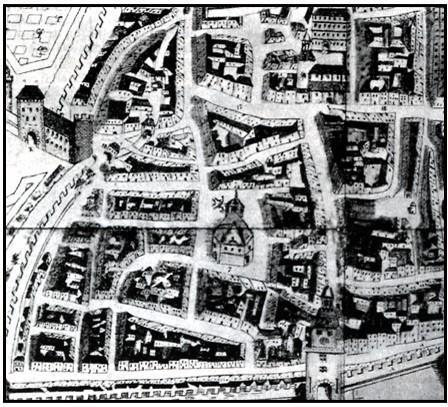
In the seventeenth century, Bergerac counted 6,000 Protestants, many of them merchants and traders.
Long before the Revocation, persecutions afflicted the region. The temple of Bergerac was destroyed as early as 1682, yet people continued to gather upon its ruins to pray and sing. In 1685, seventeen companies of dragoons obtained a collective abjuration through their violence, but resistance remained steadfast. Many Reformed emigrated to England and Holland.
In the eighteenth century, the region paid a heavy toll during the period of the Desert: more than 500 prisoners and 60 galley slaves, among them Jean Marteilhe.
La Force adhered to the Reformation from 1560. The present temple was built under Henry IV in 1604 by the Duke of Caumont-la-Force; it depended upon the château and was not destroyed, the duke having declared it converted into a chapel. The château itself was demolished during the Revolution. La Force remains known today for the work of John Bost.
To the south of the Dordogne, the Château of Duras, belonging to the Durfort family, who were Protestants until 1665, hosted Jeanne d’Albret commander of the Protestant army against the royal army of Louis XIII.
At Lacapelle-Biron was born Bernard Palissy, who died imprisoned in the Bastille in 1590 for having refused to convert to Catholicism.
The pastors of the Desert, Viala and Loire, preached in the Dordogne Valley between 1740 and 1744.
Thereafter, the situation gradually stabilised.
Reformed practices were so deeply rooted that even during the Revolution, worship continued uninterrupted at Sainte-Foy and Bergerac.
In 1803, there remained 2,000 Reformed around Sainte-Foy and 5,000 around Bergerac.
The Society for the History of Protestantism in the Dordogne Valley, at Sainte-Foy-la-Grande, preserves the archives and objects of the parish communities of Gironde and Dordogne.