Formation

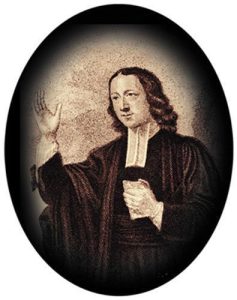
John Wesley was born in 1703 into the family of an Anglican minister, Samuel Wesley (1662–1735), then rector of Epworth. His parents came from a strictly Puritan background. His maternal grandfather, Dr Annesley, was one of the leading theologians of Puritanism. His paternal ancestor, a lay preacher, suffered as a result of the religious reaction following the accession of Charles II.
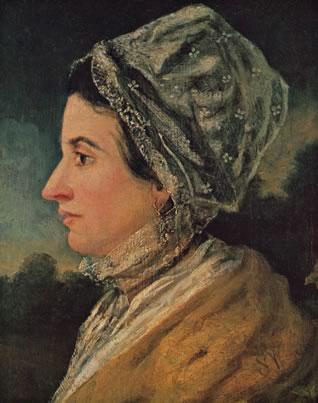
Nevertheless, his parents had early aligned themselves with the Church of England. His father, Samuel Wesley, was highly conscientious in the exercise of his pastoral office, marked by a strong sense of order and discipline, and incurred the displeasure of certain parishioners through his strictness. His mother, Susanna Wesley, became renowned for the educational method she employed with the nineteen children she raised, instilling from an early age principles of religion and piety through rigorous discipline. The young Wesley grew up in a devout Christian environment.
As a child, Wesley experienced his “baptism of fire” during the fire at the Epworth rectory, from which he was miraculously rescued. A graduate of Oxford, he served as his father’s curate from 1727 to 1729, while his younger brother Charles gathered a small circle of “pious” students, which John, upon his return to Oxford, came to lead. This Holy Club (1729–1735), a student society, was devoted to the reading of classical texts and of the Bible. Its members, highly committed to academic discipline, observed Scripture with scrupulous care and received Holy Communion weekly on Sundays at Christ Church, earning them the nickname “Methodists”.
The American Experience
In 1735, John Wesley, having been ordained an Anglican priest, travelled with his father and two friends to evangelise the Indigenous peoples of Georgia in the United States. During the voyage, Wesley learned German in order to communicate with the Moravians. After a perilous journey in which life was structured around devotion, evangelisation, and study, he arrived in Georgia. He regarded America as a “mission field”, with the declared aim of reducing Quaker influence. However, he was disappointed in his inability to undertake missionary work among the Indigenous peoples. He eventually returned to Europe, his faith shaken by his contact with the Moravians.
Before returning to the United Kingdom, he travelled to Germany, visiting Marienborn and Eisenach, the birthplace of Luther.
Back in London, Wesley continued to associate with the Moravian community. On the evening of 24 May 1738, during a “fervent meeting”, he experienced an inner assurance of the forgiveness of his sins and felt his “heart strangely warmed”. That day marked his “second birth”. He discovered that salvation depended on Christ alone. This experience of conversion became a defining feature of Methodism.
Fifty Years of Itinerant Ministry in the Service of Faith
John Wesley’s life followed an exemplary routine: rising at 4 a.m. each morning to hold the first meeting of the day at 5 a.m. Thereafter, dressed as a clergyman but without a wig, carrying a book, and wearing riding boots for the poor roads, Wesley set out on horseback after carefully preparing his journey. In wind or rain, snow or scorching heat, he gathered the Methodist community once he reached the village where he was expected. If the Anglican minister permitted him the use of the church, he gladly preached there. If the crowd was too large, he spoke from the porch or a window. If access was denied, he preached in a market hall, a barn, beneath a large tree, on the beach, or in a meadow. In any case, once or twice a day he delivered an impromptu address in the main street, standing on a chair or a large stone. Since people did not come to the churches, he went to meet them in the streets or as they left work.
This itinerant pastoral life lasted forty-eight years. An indefatigable and frugal traveller, he would stop for a few days in a town, pass through villages exhorting crowds to conversion, and then continue his journey for weeks, returning to London only briefly in order to prepare further preaching tours. Nothing reflects more clearly Wesley’s activity and faith than the disciplined monotony of his existence.
Faith and Law
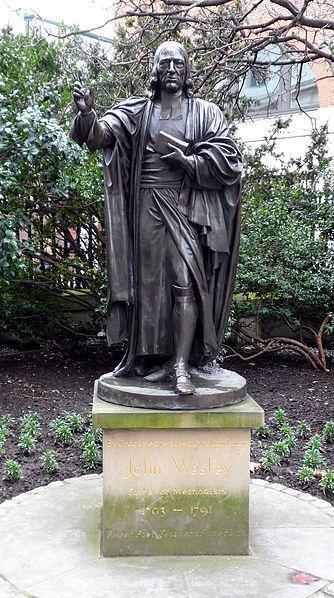
In 1741, Wesley separated from Lutherans and Calvinists. He criticised the former for their exclusive emphasis on grace to the detriment of the Law, and the latter for their doctrine of predestination. His father, a devoted supporter of the High Church, also opposed Calvinism, and Wesley retained throughout his life a strong aversion to what he called the “horrible decree”.
Wesley aligned himself with Arminianism in opposition to Calvinist doctrine. Authentic Christianity, for him, was attained through conversion; one must therefore be “awakened” to the true faith. This awakening, this spiritual resurrection, drew directly on the Epistle to the Ephesians. It implied a return to the primitive Church, to “scriptural Christianity” or the Christianity of the early Church. Wesley consistently opposed the doctrine of predestination to that of sanctification. For him, predestination “renders the preaching of the Gospel unnecessary; tends to destroy all efforts towards holiness and all religious zeal; renders revelation unnecessary while making it self-contradictory; and undermines the character of God by presenting Him as partial and unjust”.
Wesley did not reject the moral law: the believer obeys the law of love, summarised as: “You shall love the Lord your God with all your heart, with all your soul, with all your mind, and with all your strength … and your neighbour as yourself” (Mark 12:30).
By preaching the God who reveals Himself, Wesley spent his life opposing the deism of the Enlightenment. Yet his doctrine of perfection bears resemblance to a Christianised, optimistic humanism. In practice, Wesley vigorously fought against sin. A man of principle with a strict and rigorous logic, he refused to yield to a resigned fatalism derived from Calvinism.
Neither Sect nor Church
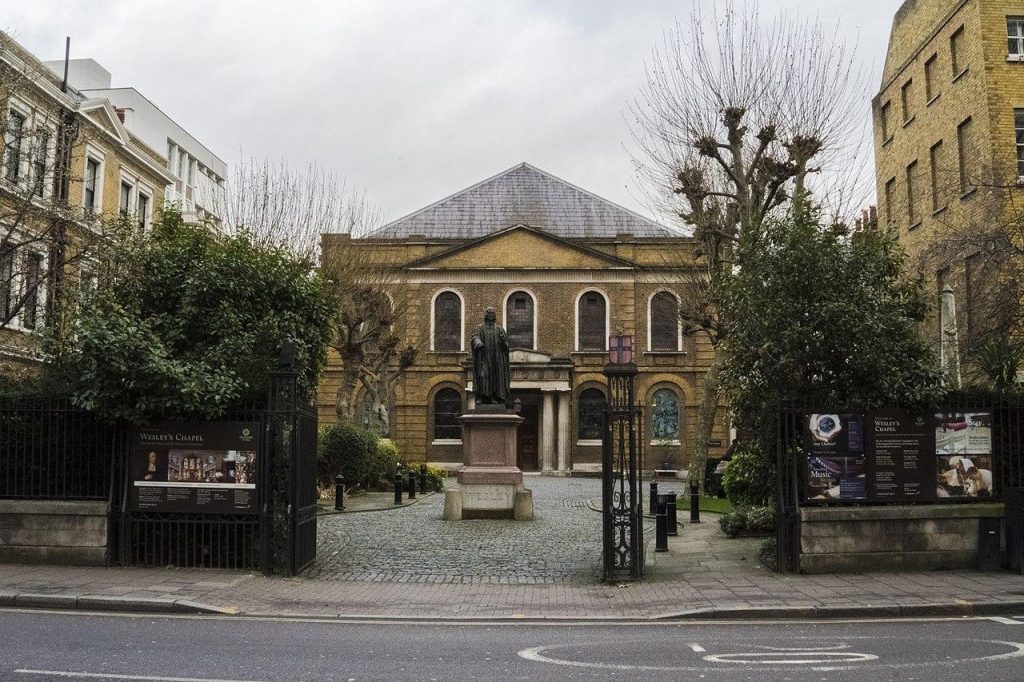
John Wesley was one of the greatest preachers in the history of the Church. His preaching was simple, stripped-down, powerful, precise, and incisive. His spoken sermons, delivered without notes, began in 1733. The published sermons are not necessarily identical to those actually preached: they were intended to instruct Methodists and present his theological position to a wider audience. They are doctrinal sermons in the sense of a theology directed towards practical Christian living.
Wesley never published a systematic theology nor a work comparable to Calvin’s Institutes of the Christian Religion or Luther’s theological treatises. In defining the beliefs of the Methodist movement, he referred to three main sources: the Minutes of the Methodist Conferences (annual synods from 1744 onwards), his Explanatory Notes upon the New Testament, and his standard sermons.
The Conference Minutes addressed not only organisational and disciplinary matters, but also doctrinal questions, particularly in the early years. The most important decisions were collected in the Minutes of Several Conversations (1763).
Wesley published his Explanatory Notes upon the New Testament (1754), drawing on earlier works by John Guyse (1680–1761), Philip Doddridge (1702–1751), and the German Pietist Johann Albrecht Bengel (1687–1752). His sermons were collected in volumes (Sermons on Several Occasions). Four volumes known as the “Standard Sermons” provided a doctrinal framework for those preaching within Methodist societies.
The Twelve Rules for Preachers
- Be diligent. Never remain idle for a moment. Do not busy yourself with trifles. Do not waste time, and never devote more of it to any task than is strictly necessary.
- Be serious. Let your motto be: “Holiness unto the Lord.” Avoid all levity, jesting, and frivolous conversation.
- Associate rarely and cautiously with women, especially the young.
- Undertake nothing regarding marriage without much prayer and consultation with your brethren.
- Do not accept evil reports about anyone. Believe nothing against another unless you have witnessed it yourself. In all things, adopt the most charitable interpretation. Remember that judgement should incline in favour of the accused.
- Speak ill of no one, lest your words fester like a sore. Keep your thoughts to yourself until you are in the presence of the person concerned.
- Tell each person plainly and promptly what you find wrong in them, lest your heart be infected. Quickly cast out such fire from your bosom.
- Do not behave as a grand gentleman. It would suit you no better than imitating a dancing master. A preacher of the Gospel is the servant of all.
- Be ashamed of nothing except sin; neither of gathering wood (if you have time), nor of drawing water, nor of polishing your shoes or those of others.
- Be punctual. Do everything precisely at its appointed time. In general, observe the rules rather than seek to alter them,not out of fear, but out of conscience.
- You have nothing else to do but to save souls. Therefore devote yourself and expend yourself upon this work. Go not only to those who need you, but especially to those who need you most. Remember: it is not your task merely to care for this or that society, but to save as many souls as you can and to advance them in that holiness without which none shall see the Lord.And do not forget that a Methodist pastor must attend to all points, large and small, of discipline. Therefore, you need to use all the common sense and all the faculties you may possess.
- Act in all things not according to your own will, but as “sons of the Gospel”. You must employ your time as we direct, devoting part to preaching and visiting from house to house, and part to meditation and prayer. Above all, if you labour with us in the Lord’s vineyard, you must undertake the work assigned to you at the times and places judged most suitable for the glory of God.
Also to discover:
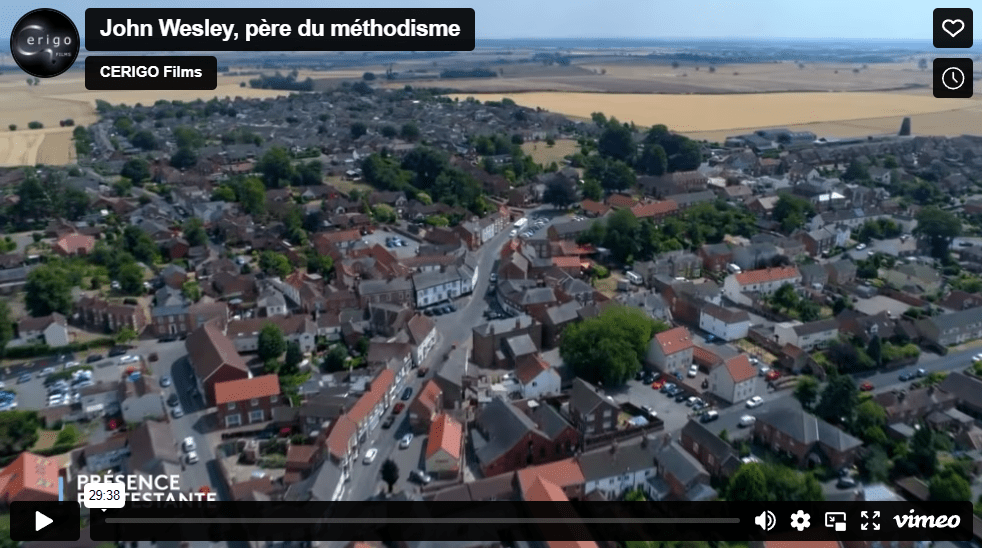
John Wesley, Father of Methodism (film by Jean-Yves Fischbach)