His Life
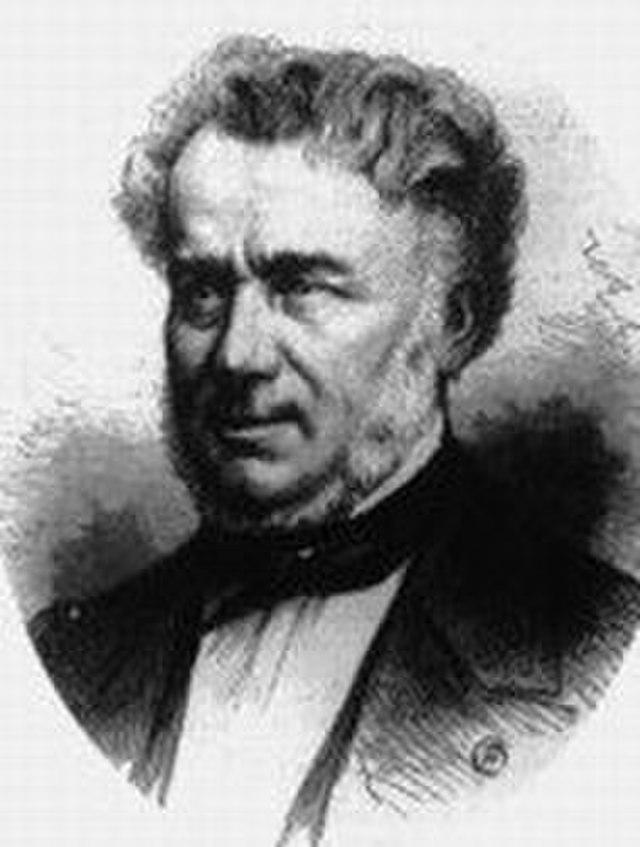
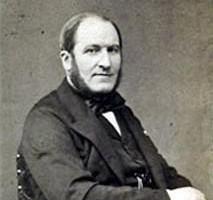
Victor Baltard was born on 10 June 1805 in Paris. He was the son of Louis-Pierre Baltard, a Catholic architect, and of Amélie Romain-Debrasseur, a convert to Lutheran Protestantism. Like his nine brothers and sisters, he was brought up in the Protestant faith. On 8 October 1833, at the Lutheran church of Les Billettes, he married Adélaïde Lequeux, with whom he had a daughter, Pauline, who converted to Catholicism in order to marry Edmond Arnould in 1853.
After classical studies at the Sorbonne, he was admitted first to the École des Beaux-Arts, architecture section, in 1823, and then in 1827 to the painting section. Awarded the Prix de Rome in 1833, he spent five years at the Villa Medici. During his stay, he developed a passion for ancient monuments and formed friendships with the painters Hippolyte Flandrin, a renovator of religious painting, and above all Jean-Auguste-Dominique Ingres; Baltard later designed both their tombs in the Père Lachaise Cemetery.
He returned to France at the time of the return of the ashes of Emperor Napoleon I and took part in the competition for the Emperor’s tomb. Ranked first, he received a gold medal, which he immediately sold. Nevertheless, he was defeated by a competitor named Visconti; however, the recognition he gained enabled him to receive commissions and, above all, to enter public administration.
Appointed Inspector of Fine Arts for the City of Paris in 1842, he spent his entire career there, serving successively as curator of diocesan buildings, Inspector General of Civil Buildings, and finally Director of the Architectural Service in 1860. President of the Central Society of French Architects, he was elected to the Académie des Beaux-Arts in 1863 and, in the same year, promoted to Officer of the Legion of Honour. A cultivated man, he was also a member of the Association for the Encouragement of Greek Studies in France.
He died in Paris at the age of sixty-eight on 13 January 1874. His funeral service was held on 15 January 1874 at the Lutheran Church of the Redemption.
Civil Buildings
In 1845, he supervised the construction of the new Stamp Office. He subsequently worked on the decoration of the Hôtel de Ville, building its grand staircase (now destroyed), as well as the temporary structures used for the great ceremonies of the Second Empire, and later on the great abattoirs of La Villette. He was also the designer of the ceremonial cradle presented by the City of Paris to Emperor Napoleon III on the occasion of the birth of the Imperial Prince in 1856.
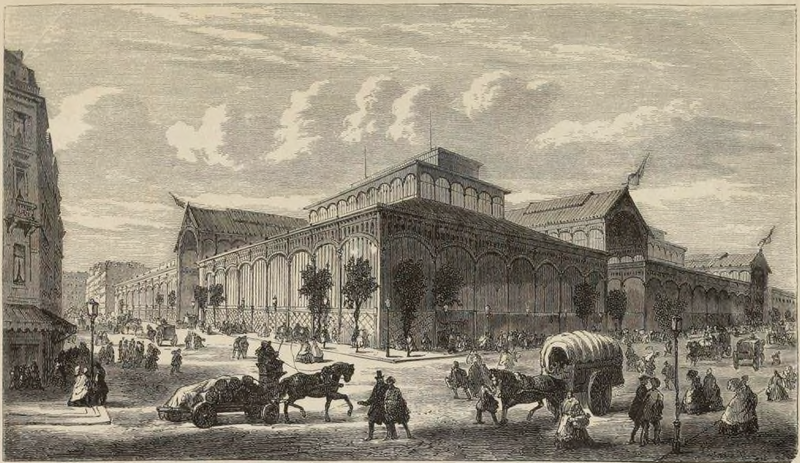
His best-known work is the complex of pavilions of the Central Markets of Paris. Following Louis-Philippe, Napoleon III revived Napoleon I’s project to rebuild what had been, since the twelfth century, the central market of Paris, a project known as “the Louvre of the people”. In 1853, Baltard proposed a design accepted by the Municipal Council after lengthy debates. A first pavilion was constructed but, judged too heavy, it was nicknamed “the fortress of Les Halles”, it and was demolished. Baltard refined his design for the twelve pavilions by making judicious use of iron, cast iron, brick, and vast glass roofs. The result was an unprecedented success and was imitated throughout the world. The entire complex was demolished in the early 1970s, following the transfer of Les Halles to Rungis, in favour of an underground shopping centre known as the Forum des Halles. One pavilion, however, was preserved and rebuilt at Nogent-sur-Marne.
Catholic Churches
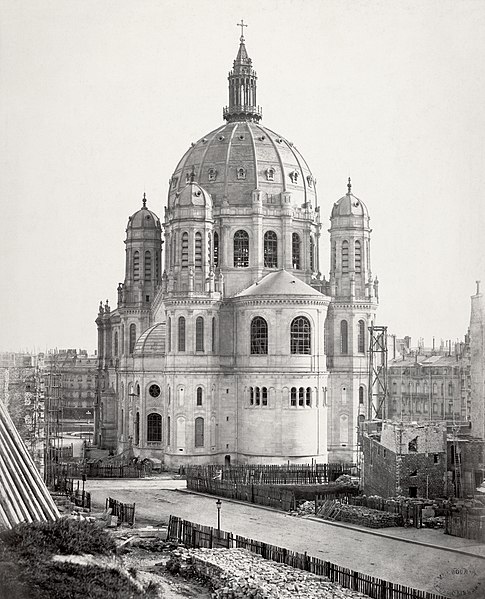

His municipal responsibilities led Baltard to supervise the maintenance and decoration of the churches of Paris, notably Saint-Eustache, Saint-Merri, Saint-Séverin, Saint-Thomas d’Aquin, Saint-Philippe du Roule, and many others. Under his influence, mural paintings gradually replaced framed canvases: the model for this transformation was Saint-Germain-des-Prés, where his friend Flandrin created an archaic style of decoration.
He also built the Church of Saint-Augustin, his most celebrated work, which represented a genuine technical feat. The quadrangular and excessively narrow site had discouraged all the other candidates; through the use of iron frameworks, Baltard succeeded in raising the choir, surmounting it with a baldachin, and constructing, without buttresses, a dome more than sixty meters high.
Protestant Churches

Baltard wished to build a Protestant church opposite Saint-Augustin, but the project met with the opposition of Empress Eugénie who, wishing to be buried in that church, could not tolerate the idea of a Protestant temple being visible from the forecourt. She insisted that it be relegated to a nearby side street, Rue Roquépine, with a discreet façade and without a bell tower (the present small bell turret was only added at the beginning of the twentieth century).
The overall design of the Church of the Holy Spirit is remarkable for its modernity and functionality, with an octagonal hall capable of accommodating seven hundred worshippers, making it one of the largest Protestant churches in Paris. The hall is illuminated by a skylight, while spacious circulation areas serve the entire building.
Baltard was also the architect of the Protestant church at Nérac in the Lot-et-Garonne region.
The abbey church of Pentemont, assigned to the Protestants in 1802 by Napoleon, was only returned to them in 1844 after considerable difficulties, and Baltard was entrusted with its adaptation. He sealed the monumental doorway and transformed two side windows into entrances, installed wood panelling with hymn boards, and added a double staircase pulpit. A large part of this work disappeared during a “renovation” carried out in the 2000s.