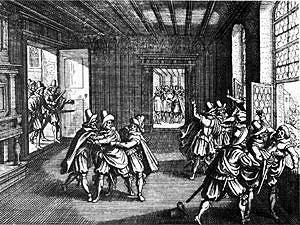
In 1618, a conflict broke out in Bohemia, within the Holy Roman Empire, for both religious and political reasons. It developed into a war involving most European states. For three decades, it devastated the principalities of the Holy Roman Empire, claimed the lives of approximately three million people, and profoundly transformed Europe.
A Fragile Balance Since 1555
Following the Protestant Reformation initiated by Martin Luther and the resulting divisions between Catholics and Protestants, the Holy Roman Empire had achieved a measure of stability through the Peace of Augsburg of 1555. Under its terms, the Emperor granted the German princes the freedom to choose either the Catholic or the Lutheran faith, which would then become the religion of their principality according to the principle cuius regio, eius religio (“the religion of the ruler determines the religion of the realm”).
However, two major problems remained unresolved. Firstly, Calvinism was not included within the scope of the agreement. Secondly, the ownership of ecclesiastical property continued to be a source of contention.
1618: The Outbreak of War
Ferdinand of Habsburg, the new King of Bohemia and future successor to the Emperor, pursued a pro-Catholic policy that disregarded the religious freedoms of the Protestant princes. On 23 May 1618, these princes, assembled at Prague Castle, threw the King’s representatives from a window in the event known as the Defenestration of Prague.
Subsequently, the Bohemian nobility deposed King Ferdinand and replaced him with Frederick V of the Palatinate, a Protestant ruler. Military conflict then began, with the Austrian Habsburg forces on one side the Protestants of Bohemia and the Palatinate on the other.
1625: The Conflict Becomes a European War
Following his victory at the Battle of White Mountain in 1620, Ferdinand embarked upon the forcible Catholic reconquest of Bohemia. This policy led to the expansion of the conflict throughout the Empire and eventually beyond its borders when King Christian IV of Denmark decided, in 1625, to intervene in support of the Protestant cause.
In response to the Emperor’s military successes, the Protestant King Gustavus Adolphus of Sweden entered the war from 1629 onwards, both to protect his fellow Protestants and to extend Swedish influence along the Baltic coast.
Catholic France provided financial support to Sweden and, in 1635, entered the war itself. Its motives were not primarily religious; rather, France felt increasingly threatened by the power of the Habsburg dynasty, which ruled both the Holy Roman Empire and Spain.
The Exhaustion of the Belligerents Opens the Way to Negotiation
The prolonged conflict exacted a heavy price. It exhausted military forces and drained financial resources. The German territories were left devastated, having suffered extensive pillage and destruction at the hands of armies composed largely of mercenaries who lived off money and provisions stolen from local populations.
The war was accompanied by mass migrations, famine, disease and epidemics. The population of Central Europe declined by approximately thirty per cent between the beginning and the end of the conflict, with losses reaching as high as sixty-five per cent in certain regions.
Peace negotiations began in 1644, but progress proved difficult. The Emperor’s diplomats negotiated in Münster with the Catholic princes and France, while separate discussions took place in Osnabrück with the Protestant princes and Sweden. Four years later, the belligerents succeeded in signing two peace treaties, which came into force in October 1648.
1648: The Treaties of Westphalia
Peace was celebrated throughout Europe after a conflict that had been both protracted and exceptionally destructive.
The negotiations sought to establish a lasting settlement by resolving the two principal issues that had fuelled the war:
- Religious Conflicts : The treaties established a durable religious peace by recognising Calvinism as the third official confession of the Empire, on an equal footing with Catholicism and Lutheranism. They also permitted religious coexistence within each territory.
- Political Rivalries : The treaties redefined the constitutional structure of the Holy Roman Empire by reducing the powers of the Emperor and granting each state the right to manage its own affairs independently and to conclude alliances. France and Sweden were designated as guarantors of peace and of the liberties enjoyed by the princes of the Empire.
The Treaties of Westphalia did not bring an end to all hostilities, since the war between France and Spain continued until 1659. Nevertheless, they represented a major diplomatic achievement. By involving all the principal states in the negotiations, they succeeded in creating a new balance: a balance within the Holy Roman Empire itself, and a broader balance throughout Europe.
The Westphalian system sought to safeguard Europe against any attempt by a single power to establish hegemony over the continent.