A Perilous Voyage
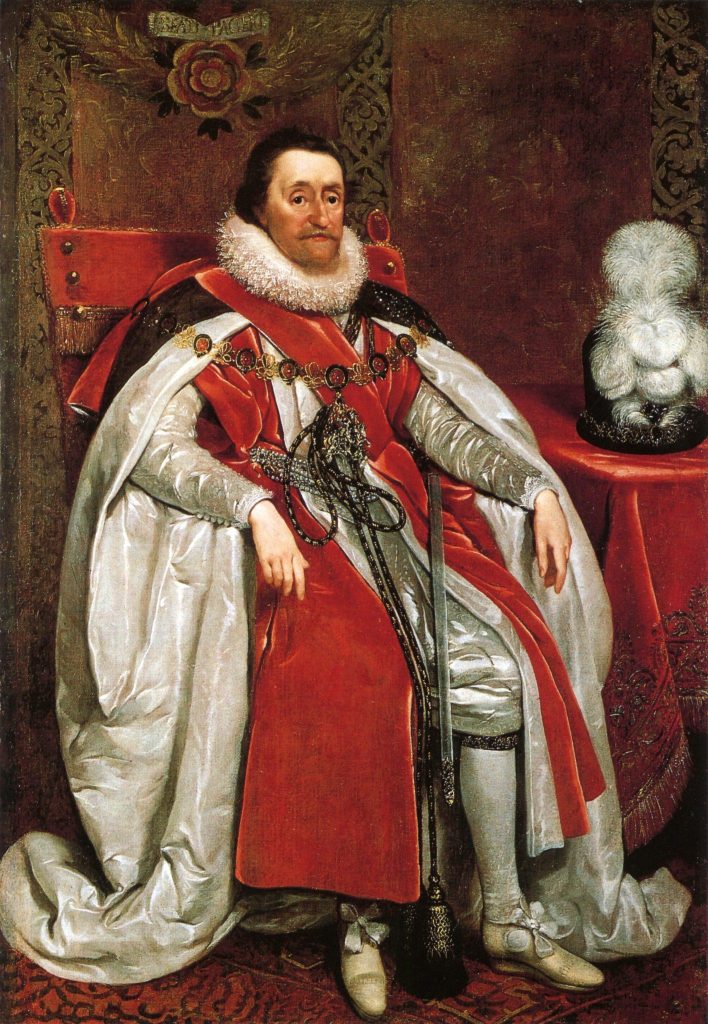
In 1603, James VI of Scotland, son of Mary Stuart, became King of England and Ireland under the title of James I. He defended the Church of England against religious dissent and showed little tolerance towards the Puritans, who were regarded as being outside the established religious order.
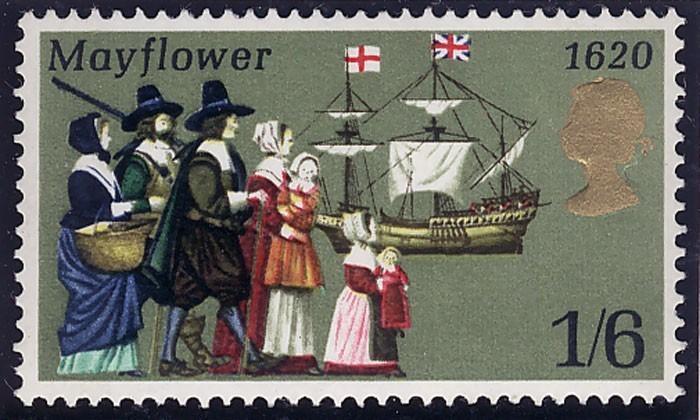
In July 1620, a group of English Puritans, wishing to practice their religion freely, set out to emigrate to North America. Two vessels were fitted out for the journey: the Mayflower, carrying sixty-five passengers from the Thames in England, and the Speedwell, bringing Puritan refugees from the Netherlands, most of them English members of the Leiden congregation.
The two ships were to rendezvous off Southampton before departing in early August. However, damage sustained by the Speedwell required repairs at Dartmouth. After setting sail once more, a further leak developed some two hundred miles from the coast. Both vessels therefore returned to Plymouth, where it was decided that the Speedwell would be abandoned. Some of her passengers transferred to the Mayflower, while the remainder returned to the Netherlands.
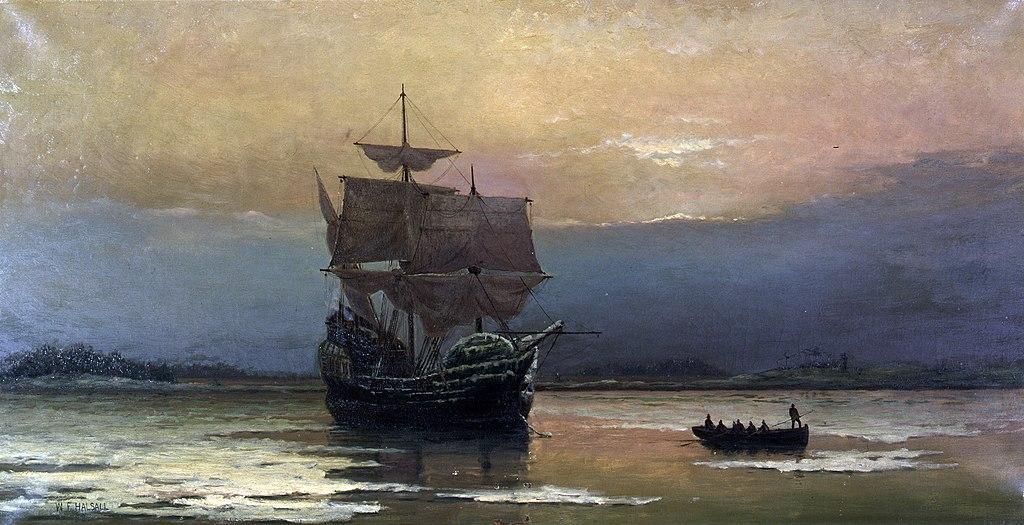
The Mayflower finally departed Plymouth alone on 6 September 1620, intending to reach Virginia, where an English settlement had already existed since 1607. She was a three-masted vessel of approximately 180 tons, measuring twenty-seven meters in length and equipped with cannon. On board were 102 passengers, men, women and children, including around thirty-five Puritans, together with a crew of approximately thirty men.
During the crossing, the ship encountered severe storms and, on 9 November, sighted Cape Cod in what is now the state of Massachusetts, New England. Adverse weather thwarted an attempt to continue towards Virginia, and the Mayflower eventually cast anchor in Cape Cod Bay on 11 November 1620.
The Beginnings of the Colony
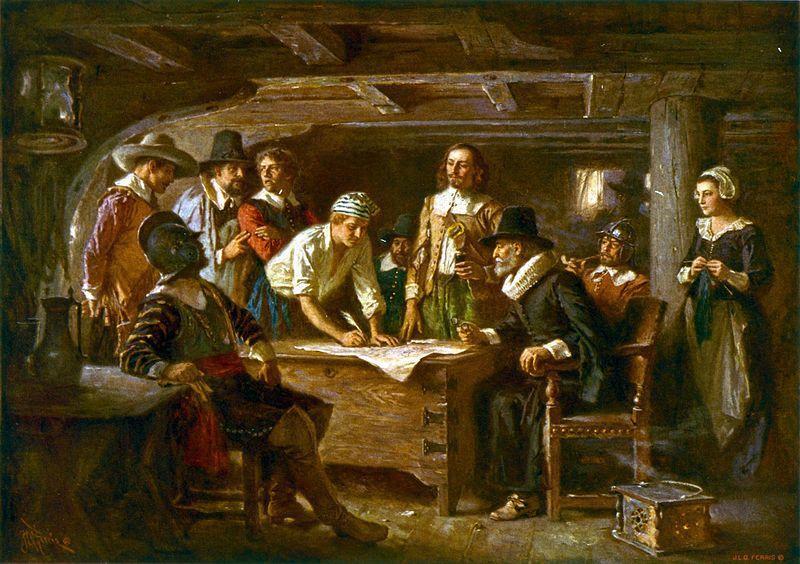
Before disembarking, the male passengers held a council, and forty-one of them signed an agreement establishing the framework of the future colony: the Mayflower Compact.
In this document, the signatories pledged allegiance to King James I of England and solemnly agreed, before God and one another, to constitute themselves as a civil political body, to enact just and equitable laws for the good of the colony, and to submit to those laws.
During the winter of 1620–1621, the passengers remained aboard the ship. Disease, severe weather and shortages of food caused the deaths of nearly half the settlers. The crew was likewise affected.
In March 1621, the survivors came ashore and settled in simple dwellings, while organising defenses against any possible attack by Indigenous peoples. These measures were directed by Captain Myles Standish (c. 1584–1656), assisted by Christopher Jones, captain of the Mayflower. In April, Jones returned the vessel to England with the surviving members of the crew.
Fortunately for the settlers, the local Indigenous peoples proved peaceful and taught them the cultivation of maize as well as fishing techniques.
The colony’s first elected governor, John Carver (1576–1621), was a businessman who had played an important role in organising the expedition.
His successor, William Bradford (1590–1657), who was elected in 1621 and repeatedly re-elected until 1644, had come from the Netherlands. He later wrote a chronicle covering the colony’s first thirty years. In the autumn of 1621, he organised a celebration marking the anniversary of the settlers’ arrival, giving thanks both to God and to the Indigenous peoples who had helped secure their first successful harvest. He also established a day of rest for the colony.
The settlers named their settlement New Plymouth, later shortened to Plymouth, after the English port from which they had departed.
A Foundational Episode in American History
The colony established by the passengers of the Mayflower was not the first settlement founded on the eastern coast of North America. Nevertheless, it has come to be regarded as one of the founding episodes of the American nation because, more than any other early settlement, it embodied an ideal of liberty.
The biblical outlook of the Puritans left a deep imprint upon American culture. They compared their Atlantic crossing to the Hebrews’ passage through the Red Sea and viewed their settlement in the New World as analogous to the Israelites’ settlement in the Promised Land.
It was consequently the Massachusetts Bay Colony that founded Harvard College in 1636. In its early years, the institution was strongly influenced by Puritanism and trained many ministers.
The Mayflower Compact also served as an inspiration for the Constitution of the United States. President George Washington (1732–1799) selected Thanksgiving as the occasion on which to celebrate the ratification of the Constitution, and in 1863 President Abraham Lincoln (1809–1865) designated the fourth Thursday of November as the official date of the observance. Thanksgiving has been a federal public holiday since 1941.
Today, it has become largely a secular celebration, during which families gather for a substantial meal traditionally featuring boiled maize, potatoes and turkey.
Thanksgiving is also celebrated in Canada on the second Monday of October as a harvest festival.
The Puritans who travelled aboard the Mayflower were first referred to as Pilgrims in 1793 and, from 1820 onwards, as the Pilgrim Fathers. The descendants of the passengers, often regarded as a form of American aristocracy, are numerous and include eight Presidents of the United States.