Quartier des Victoires

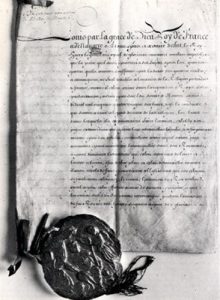
The Edict of Nantes, signed in 1598, was supposed to be periodically revised after the death of Henry IV. As royal power in France grew stronger and its military conquests expanded, the rights granted to Protestants steadily diminished until the revocation of the Edict of Nantes in 1685 by the Edict of Fontainebleau. The Victoires district (Place des Victoires), in Paris’s 2nd arrondissement, bears traces of these changes.
At the Palais Brongniart, at the Bourse metro station, take Rue de la Banque towards the Louvre Museum. You will soon come to Place des Petits-Pères, where the Basilica of Notre-Dame des Victoires stands. At the time of the siege of La Rochelle against the Protestants in 1628, Louis XIII had vowed to build a church dedicated to Mary in the event of victory. The foundation stone was laid in 1629 in the presence of Jean-Baptiste Gondi, the future Cardinal de Retz, on the site of a convent of the Petits-Augustins, known as the Petits-Pères. The church, still provisional at the time, was used until 1666. It became the sacristy of the present building. Various plaques commemorate these events.
Leaving Place des Petits-Pères, take Rue Notre-Dame des Victoires towards the Louvre. This leads to Place des Victoires, which was built in 1680 to designs by Jules Hardouin Mansart, to celebrate the military victories of Louis XIV that culminated in the Peace of Nijmegen in 1678.
Originally, it was an enclosed square in the shape of a horseshoe. All the houses had two storeys topped by a mansard roof, each resting on large arcades surmounted by a medallion depicting Louis XIV’s military exploits. Many of these houses were subsequently raised: the medallions can therefore be seen in the Richelieu Gallery at the Louvre; one will notice that they are not particularly kind towards Protestants.
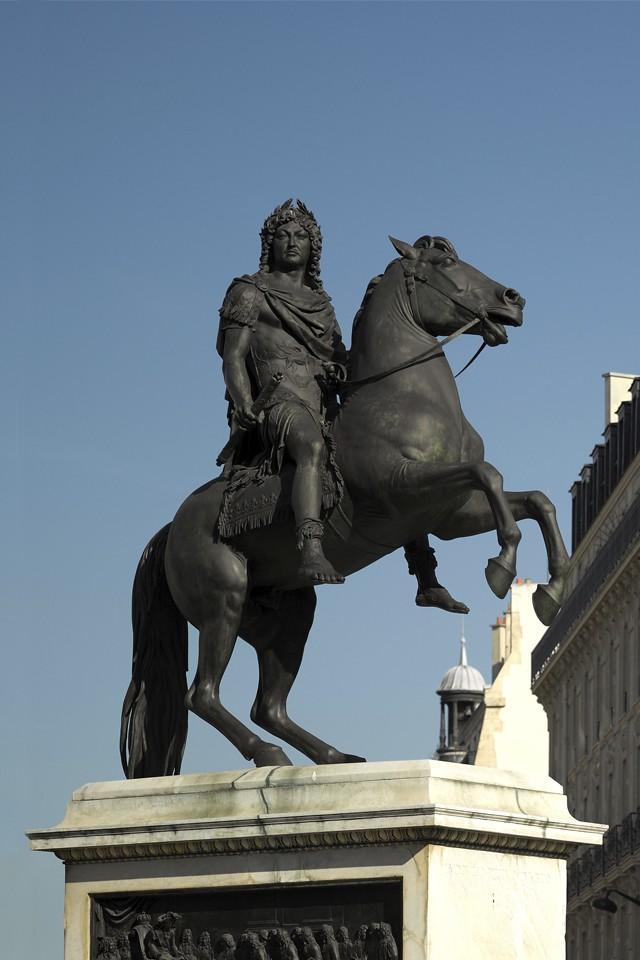
At the centre of the square stood a large full-length statue of Louis XIV. The king’s statue was melted down in 1792 during the Revolution, when the square was renamed Place des Victoires nationales. It was replaced in 1822 by the equestrian statue that can be admired there today.
By taking Rue Croix-des-Petits-Champs towards the Louvre, you can see the houses where Saint Vincent de Paul, who had served as General of the Galleys, and Bossuet, a leading opponent of the Protestants, briefly lived.