He was born in Atlanta (Georgia) on 15 January 1929 in a middle-class family, and was given his father’s name, who was a Baptist pastor too. The latter had chosen this name to honour the German reformer after a Baptist World Alliance Congress held in Berlin in 1934.
Martin Luther King Jr.’s education
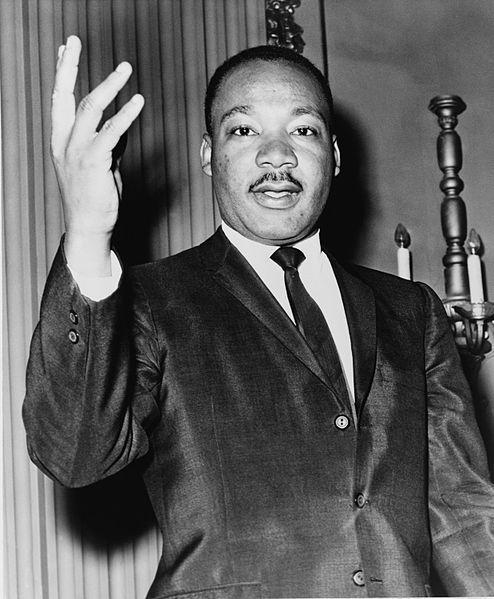
After studying sociology at Moorhouse College, historically black, Martin Luther King Jr. entered the Cromer theology seminar in Chester (Pennsylvania). In 1951, even before he had graduated in theology, he preached at the Ebenezer Baptist Church in Atlanta where his grandfather, Adam Daniel Williams, the son of a minister too, had officiated.
In 1953, he married the daughter of a Baptist pastor who bore him two daughters and a son. He started preaching at Dexter Avenue Baptist Church in Montgomery (Alabama) when he was twenty-five, and got his Doctorate in Theology at Boston University in 1955. He asked all his followers to join the National Association for the Advancement of Coloured People (NAACP) meant to promote the fight against exclusion and social inequalities.
His early non-violent commitments in Montgomery: the bus boycott
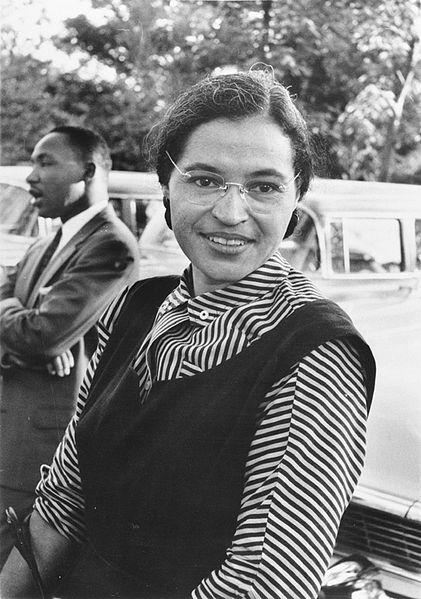
On 17 May 1954, the Supreme Court of the United States declared segregation in schools unconstitutional, which encouraged overcoming any insubordination. Thus did Rosa Parks, an NAACP activist, refuse to give her seat to a white man on a bus on 1 December 1955. It was an act of civil disobedience and she accepted its consequences, i.e. imprisonment and fine. Martin Luther King Jr. immediately had leaflets handed out calling all black taxi drivers to organise carpooling to boycott buses, bringing Montgomery City Line to the brink of bankruptcy. Martin Luther King Jr. then started negotiating with white representatives of the company.
When he was twenty-six Martin Luther King Jr. was elected president of the Montgomery Improvement Association (MIA) aimed at helping Black people, thanks to foreign investors. He started his address to the meeting saying: “The people are tired of being thrown into the abyss of humiliation”. Montgomery was his first baptism of fire: his home was bombed in 1956. His church was dynamited soon after. He was arrested. The MIA was accused of breaching the anti-boycott law in 1956, but submitted a motion of unconstitutionality of the racial segregation law in buses. The Supreme Court ruled the law unconstitutional and buses were desegregated. It was Martin Luther King Jr.’s first success in acquiring civil rights for Black people.
Martin Luther King Jr. took part in founding the Southern Christian Leadership Conference (SCLC) pacific organisation and became its president. He demanded the right to vote for everyone. The FBI director, J. Edgar Hoover, suspected him of being involved with the communists and pushed him to wit’s end in a libellous letter sent to his wife. In 1957 Martin Luther King Jr. and his wife were savagely beaten. On 19 September 1958 as the minister was signing copies of his book “Stride Toward Freedom”, he was attacked again, but this time by a mentally ill young black lady.
India tour in the footsteps of Gandhi
In 1958 he travelled to Paris, then London, and then India, in the footsteps of Gandhi, and finally Jerusalem and Cairo. He was marked by the non-violent resistance of Mahatma Gandhi (1869-1948) who became the model for his action and philosophy. The techniques were sit-in, jails-in, wade-in and kneel-in, consisting in sit-in demonstrations meant to overload prisons and hasten liberations, to enter every segregative place, and to kneel in white churches. He went back to Atlanta in 1959. He was arrested at a sit-in, and liberated in November 1960 by John Fitzgerald Kennedy, recently elected President of the United-States, thanks to Black voters.
The fight in Birmingham
In 1963 the Ku Klux Klan spread terror after a demonstration in Birmingham (Alabama). Martin Luther King Jr. was arrested again on 13 April. He answered in a letter sent to eighteen moderate ecclesiastics of all faiths who accused him of being a troublemaker, an outsider. In this ‘Letter from Birmingham Jail’, he rebuked the accusations of his Christian and Jewish contenders in seven points:
- He overlooks the accusation of outsider as he is appointed by an association with branches all over the United-States.
- He is in Birmingham in solidarity with pervading injustice there.
- If an extremist, it is for the love of his fellow human beings, his enemies included. Was Jesus not an extremist of love? The new power, like the former one, needs to be shaken to finally act. Freedom is never voluntarily given, but must be wrenched out by the oppressed.
- We, the Black people, have been waiting for over three hundred and forty years, and can no longer wait because the word ‘wait’ almost always means ‘never’.
- Time is an ally of social stagnation forces. Asian and African countries move fast towards political independence.
- The vast majority of your black brothers suffocate in filthy prisons feeling they are nobody.
- Impatience is legitimate and inevitable.
Indeed, for Martin Luther King Jr., a lukewarm acceptance was more annoying than a simple and straightforward refusal. Action does not cause violence, but fights the illness of segregation. It shows the accumulated frustrations, a pre-existing hidden tension.
When his fourth child was born, Martin Lythe King Jr. wrote to J.F. Kennedy, and asked him to walk in the shoes of a black child growing up in Birmingham.
‘You would be born in a Jim Crow hospital (Jim Crow was a politician who forced the division between the free North and the segregationist South), your parents would probably be living in a ghetto. You would have registered in a Jim Crow school. You would spend your childhood playing on the street because ‘coloured’ parks would be inappropriate…If your family attended church, it would be a black church…You would live in a city with brutality against the blacks…You would be confronted to a general atmosphere of violence…’
He also wrote a book based on eighteen preachings entitled Loving your Enemies.
The March on Washington: ‘I have a dream’

On 22 June 1963, Martin Luther King Jr. met Kennedy. In June, he marched to Washington for freedom and jobs. In front of Lincoln’s statue at Mason Temple he made his incredibly powerful and famous speech ‘I have a dream’ in August. Great actors stood by him, namely Sidney Poitier, Mahalia Jackson, Marlon Brando, Joséphine Baker, Joan Baez, Bob Dylan…supporting a revolution that spread all over a sick country that had needed to invent the ‘nigger’ at a given time in its history.
‘I have a dream that one day on the red hills of Georgia, the sons of former slaves and the sons of former slave owners will be able to sit down together at the table of brotherhood..I have a dream that my four little children will one day live in a nation where they will not be judged by the colour of their skin but by the content of their character…that in every city, we will be able to speed up that day when all of God’s children…will be able to join hands and sing the lyrics of the old Negro Spiritual: Free at last! Free at last! Thank God Almighty, we are free at last!’
Then, Martin Luther King Jr. was put in jail where he wrote Why We can’t Wait. In 1964, President Lyndon B. Johnson decided to sign The civil rights Act. Martin Luther King Jr. announced on television, after John Fitzgerald Kennedy had, that within forty years the Americans would elect a black president, a prophecy fulfilled with Barack Obama’s election in November 2008.
The ‘Bloody Sunday’ and the victory of civil rights for the blacks in 1965
Martin Luther King Jr. led several marches for civil rights, singing Negro Spirituals referring to the roots of slavery, which united and galvanised the crowds. After he received the Nobel Peace Prize in 1964, and came back from Oslo, he was invited by President Lyndon B. Johnson at the White House to talk about a great societal project. Martin Luther King Jr. however stuck to the right to vote and resumed his protest marches. At the first one in Selma (Alabama) he was put in jail again until early February 1965.
In March, Martin Luther King Jr. decided on a new march from Selma to Montgomery that ended in a ‘bloody Sunday’. On 9 March, he led a demonstration with white and black rabbis, priests and pastors. Two days later President Lyndon B. Johnson announced on television that the cause of civil rights was heard. He concluded with the words of Martin Luther King Jr. ‘and we shall overcome ‘. Martin Luther King Jr. understood that he had won. On 3 August 1965, the National Civil Rights Act was ratified by the American Congress. The fight of the black people was the spearhead of a struggle that affected any underprivileged minority.
The struggle spread to those excluded from the economical and political power.
The struggles initiated ten years before barely dealt with the economical problems the Black were facing. In Chicago Martin Luther King Jr. discovered that 30% of the blacks won over by the ideas and the armed action of the ‘Black Power’ against police brutality, were jobless which caused riots during the sweltering Summers after long and cold Winters. On 10 July 1966, as Luther had posted his 95 theses on the doors of the church in Wittenberg in 1517, Martin Luther King posted on the door of the town-hall a call to all poor minorities to boycott businesses and enterprises which denied them the right to employment. The mayor of Chicago gave in under the pressure and negotiated an agreement to make housing access easier to solvent families disregarding colour.
Memphis and the campaign for the poor and the oppressed
Martin Luther king Jr.’s action soon reached beyond the black community and spread to declarations against the intensification of the Vietnam War in 1965. He called for stopping to shell North-Vietnam and pleaded for all the poor and the oppressed. He notably addressed a memorable speech to the auto-mobile trade-union in California. It made him the man to be shot.
In 1968, Martin Luther King Jr. was asked by the NAACP to take part in the unlimited strike of one thousand and three hundred black dustmen in Memphis. They marched in silence along the Mississippi river holding signs ‘I am a man’ and demanding to be recognised as human beings. In spite of death threats, Martin Luther King wanted to remain non-violent. He opposed the more radical ‘Black Power’ movement, the action of Malcolm X ‘the red’ converted to Islam. For Martin Luther King, Malcolm X and ‘Black Power’ were symbols of violence and could only discredit the Blacks to public authorities.
Martin Luther King Jr.’s action spread to all poor Blacks, Chicanos, Indians or Whites against the white society interested only in its tranquillity and in its social status quo. After his life was threatened, and after physical attacks as well as imprisonments, the leader of the civil rights was murdered on 4 April 1968 in Memphis (Tennessee) when 39 years old, after fighting for thirteen years. He had just made his last speech:
‘The masses of people are rising up, whether they are in Johannesburg, South Africa, in Nairobi in Kenya, in Atlanta, Memphis…if something isn’t done, and in a hurry, in the world…the whole world is doomed…Something is happening in Memphis… I ask you to go out and tell your neighbors tonight not to buy Coca-Cola… to take your money out of the banks down-town and deposit your money in “our bank”, the “Tri-State Bank”…’
in 1977, he was posthumously awarded the Presidential Medal of Freedom, and then the Congressional Gold Medal in 2004. On 2 November 1983, Ronald Reagan signed the King Day Bill instituting a new holiday in the American calendar. Every 4 April, every year, Martin Luther King Jr.’s death anniversary is observed, in all American States without exception since the year 2000.