The Pastor
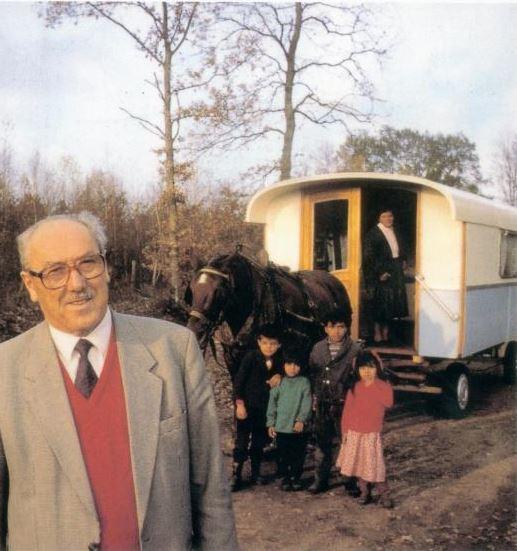
Clément Le Cossec was born on 20 February 1921 at Treffiagat, in Finistère. At the time, his father was keeper of the Jument Lighthouse, situated near the island of Ouessant.
While preparing an engineering qualification at the École des Ponts et Chaussées, he responded to a call to the pastoral ministry in 1939. He undertook several courses in theology, including correspondence studies with the Bible School and Missionary Association, and subsequently joined the pastoral body of the Assemblies of God.
Between 1944 and 1952, Pentecostalism survived in Brittany only among a few isolated families. These groups were brought together from time to time during the summer by visiting pastors. Pastor Clément Le Cossec’s first contacts with Gypsy communities took place in 1947 in northern France, while he was serving as pastor in Lille.
In 1950, he settled in Rennes, where he coordinated the emergence of newly established Pentecostal ministries throughout the towns and cities of Brittany.
Wasso Ferret, known as Balo, the first General Secretary of the Gypsy Evangelical Mission, described his work in the following terms:
“It was in 1950 that a succession of events transformed the world of those known as Gypsies, Bohemians, Romanichels and Travellers (…). Pastor Clément Le Cossec was then minister of a Pentecostal church in Lille. A young Gypsy came to ask him to pray for his mother, who was dying. Having gone to her bedside, he began to pray, and the woman was completely healed. In 1951, a dying young man in Lisieux was likewise healed. Other sick people who attended prayer meetings with Pastor Le Cossec experienced the presence of the living Christ beside them and were also healed (…). It was a remarkable discovery, carried throughout the travelling communities by hundreds and then thousands of Travellers who converted to the Gospel (…). Among them were people from every social background and condition of life, transformed as the Gospel changed their character. Mandz became the first preacher of the Gypsy Mission. His ministry would be exercised (…) within the Travelling community itself.”
From 1950 onwards, Clément Le Cossec devoted himself to the Gypsy Mission.
From 1950 onwards, Clément Le Cossec devoted himself to the Gypsy Mission.
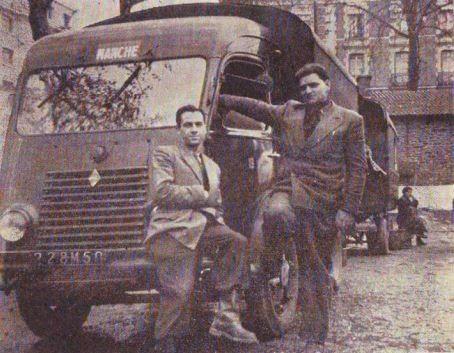

From 1951 onwards, he visited the Brest group one Monday a month, while the congregation met during the remainder of the time in various private premises.
“One of these meeting places has remained deeply embedded in the collective memory of both the Church of Brest and the evangelical Gypsy movement Vie et Lumière. The ‘Bourdoulous Cellar’, in the Saint-Marc district, became the upper room of the Gypsy Revival.”
It was in Brest that Pastor Clément Le Cossec conducted the first Gypsy baptisms. Despite strong opposition from the municipal authorities, more than one thousand Gypsies attended a first major gathering in November 1954. On the shore of Moulin Blanc, in the Saint-Marc district, a series of twenty baptisms was celebrated.
The Gypsy Revival
Pastor Clément Le Cossec relinquished responsibility for his church in Rennes in order to take to the roads and became known as “the Apostle of the Gypsies”. He trained the first Gypsy preachers, and the Revival rapidly spread to other regions of France. Entire families turned to Jesus Christ as their Saviour.
This development is described by Pastor René Zanellato, a leading historian of Gypsy Protestantism, in the document entitled The Birth of Gypsy Protestantism.
The Revival within the Gypsy community quickly gained momentum, and Le Cossec soon devoted himself almost exclusively to the development of the Gypsy movement. The movement gradually acquired its own autonomy and rapidly distinguished itself from the settled Pentecostal congregations.
Clément Le Cossec died on 22 July 2001 in Le Mans, at the age of eighty.
