Poitiers
Poitiers embraced the Reformation following Calvin’s stay there in 1534. His earliest sermons are said to have taken place in the cellars of the Collège Sainte-Marthe (now a lycée). There exists a “cave known as Calvin’s”, or the rock of Passe-Lourdin, near Saint-Benoît.
At the Château du Parc-Soubise, Calvin was received by Catherine de Parthenay (ruins near Mouchamps). Evangelical centres developed at Saint-Maixent, La Mothe-Saint-Héray, and Niort.
In 1546, Guillaume Saunier was burned as a heretic at Poitiers.
The Reformed community of Poitiers was, together with those of Meaux and Angers, one of the first three to organise itself. As early as 1557, internal regulations were drawn up. It was in the house of Jean Beaucé, Rue Le Basle, that the decision was taken to organise in Paris the first national synod, known as the Synod of Paris, in 1559.
At Loudun, the Protestant community gathered nearly 3,000 faithful. On 16 November 1659, a national synod was held there. The Revocation completely eradicated Protestantism.
The churches of Poitou were among the strongest Reformed strongholds. To the original centres were added Chauvigny, La Roche-Posay, Châtellerault, Lusignan, Melle, and Parthenay.
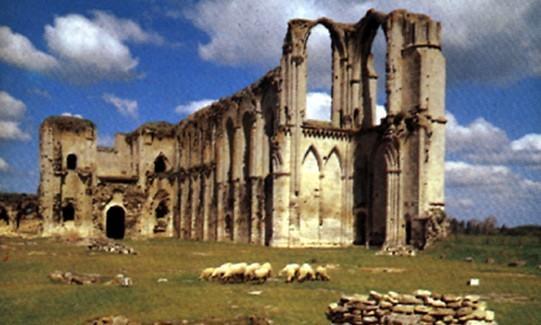
The magnificent ruins of the Abbey of Maillezais recall the memory of Rabelais, who stayed there. Having become a Protestant place of safety, Agrippa d’Aubigné served as its governor between 1584 and 1619. It was there that d’Aubigné wrote Les Tragiques and the Histoire universelle.
Coligny Defeated at Moncontour
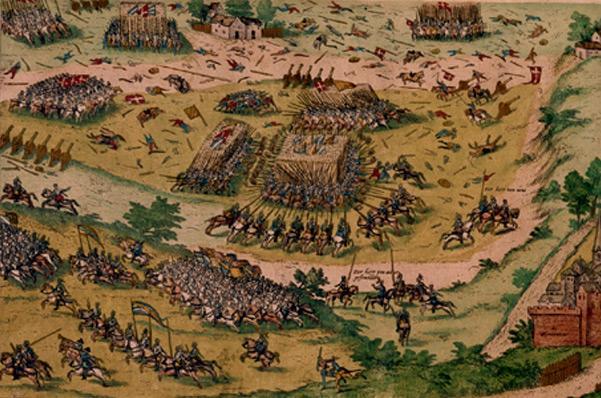
In 1569, Admiral Coligny laid siege to Poitiers. The “Rock of Coligny” marks the site where he established his batteries during the siege. In 1570, he was defeated at Moncontour.
In the seventeenth century, there were approximately 90,000 Protestants in Poitou, distributed among three colloquies:
– the colloquy of Bas-Poitou (present-day Vendée),
– the colloquy of Haut-Poitou (around Poitiers and Châtellerault, Thouars, Parthenay, etc.),
– and the colloquy of Moyen-Poitou (present-day Deux-Sèvres), comprising half of Poitevin Protestantism around Niort, Melle, and Saint-Maixent.
To the south of Niort, in 1639, at the Château d’Olbreuse, was born Éléonore Desmiers d’Olbreuse, future wife of the Duke of Brunswick-Lüneburg, who protected persecuted Huguenots.
The Dragonnades in Poitou
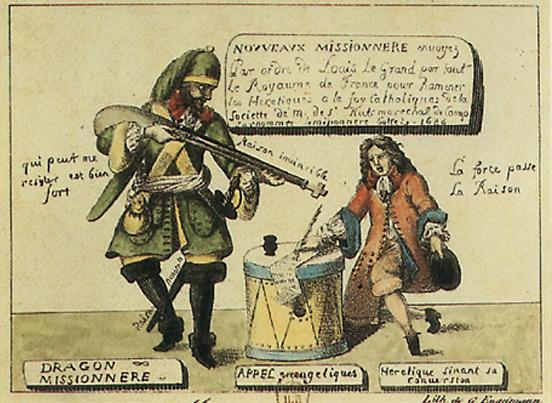
From 1681 onwards, Poitou suffered the persecutions of the “booted missionaries”. The Intendant of Poitou, Marcillac, laid waste the entire region with his dragoons, employing brutal methods, beating and “roasting” the Huguenots. Thirty-eight thousand abjured, while others went into exile; Marcillac was eventually dismissed.
In 1685, the dragonnades resumed with the troops of the Marquis d’Asfeld. The temples were razed, and clandestine Protestantism was organised.
Assemblies of the Desert Multiply
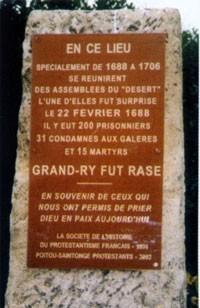
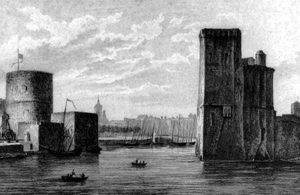
These assemblies had their martyrs: Jean Migault, a schoolmaster, was imprisoned in the Tower of Saint-Nicolas at La Rochelle. Near Mougon, an assembly of 1,500 people at prayer was surprised at Grand-Ry by dragoons, who “shot them like pigeons”.
Around 1718, religious fervour intensified. Underground organisation developed: gatherings took place on the sites of demolished temples; worship was held in houses (such as the barn-temple of Avallon); and the dead were buried in small family cemeteries. Preachers came to encourage the clandestine faithful: Jean Chapel in Bas-Poitou in 1720 and 1728, Michel Viala in 1740, André Migault, Jean-Baptiste Loire, and Pierre Gamain.
On the eve of the Revolution, the resistance of Poitou had borne fruit: Poitevin Protestantism still formed a coherent whole to the east of Niort and as far as the Vienne.
The Museum of Protestant Poitou
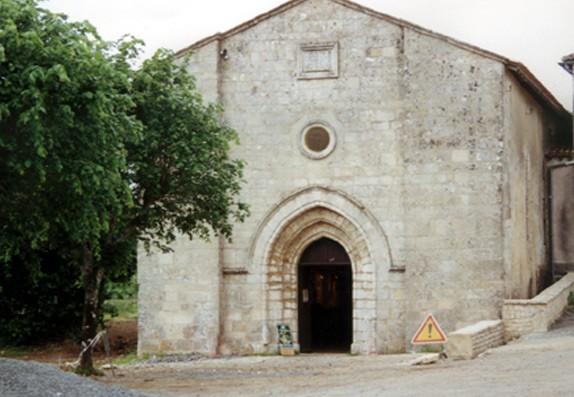
At Beaussais and La Couarde, it presents the history of this region.
After the Revolution, there were still 30,000 Protestants in Deux-Sèvres and 3,000 to the east of the Vienne.
Several Protestant museums preserve the memory of the Protestant history of this region.